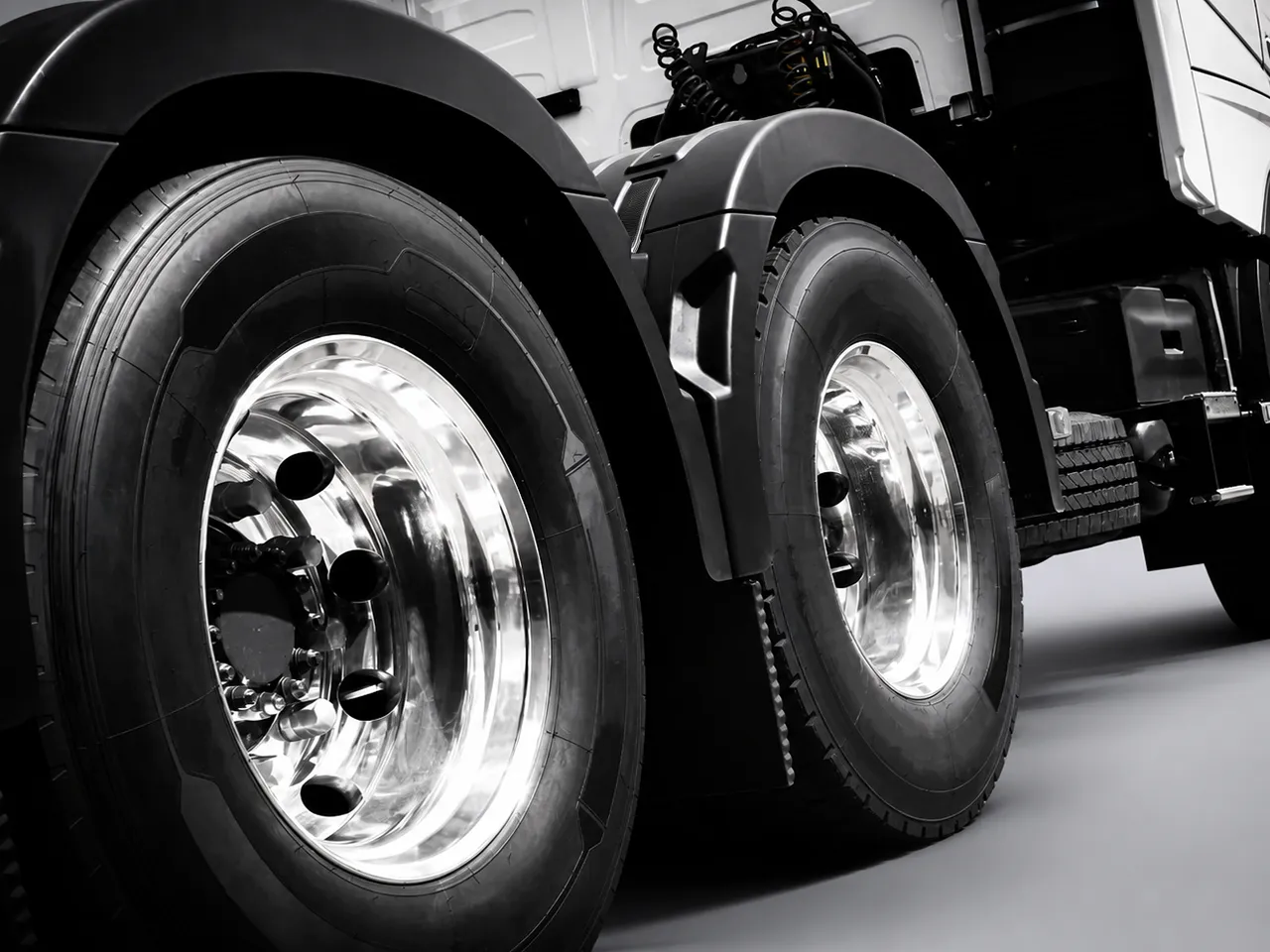
Semi-Trailer Tire & Wheel Selection Guide: 12R22.5 vs 295/80R22.5, Steel vs Aluminum

Lead Engineer, Kales Vehicle
Choosing semi-trailer tires and wheels is not a routine parts decision. It directly affects payload, fuel economy, casing life, brake heat control, and workshop risk. For fleets running across Africa, Central Asia, Southeast Asia, South America, and Australia, the right specification is the one that matches the harshest real section of the route, not the smoothest part of the brochure route.
Quick Answer for Fleets
- Choose 12R22.5 when your trailer needs more sidewall height, more ground-clearance tolerance, and better survival on rough or mixed-surface routes.
- Choose 295/80R22.5 when your trailers spend most of their time on paved, higher-speed highway work where lower ride height and more stable highway behavior matter more.
- Choose 11R22.5 for standard-load, medium-duty, urban, and legacy applications only after confirming that its load index covers the actual axle load.
- Radial tires usually make more sense for long-haul paved work because they run cooler and more efficiently, while bias tires still earn their place in severe off-road and mining service.
- Forged aluminum wheels are a weight-and-heat decision, not just a cosmetic upgrade. They can recover useful payload, but the hub stud length and re-torque protocol must be checked first.
- If your fleet is considering super single tires, pair the change with TPMS or ATIS. On remote corridors, blowout management matters as much as fuel savings.
KALES route-first rule: spec trailer tires and wheels for the worst 10% of the route, because that is where sidewall cuts, rim damage, brake heat, and downtime usually start.
Why Tire and Wheel Spec Is a Fleet Profit Decision
On a semi-trailer axle group, tires and wheels control more than rolling. They influence deck height, trailer stability, tread wear rate, bearing and suspension load, downhill heat behavior, and how much dead weight the fleet is dragging every kilometer. That is why tire and wheel selection belongs in procurement planning, not only in the workshop after the trailer is already built.
For a long-haul tractor-trailer logging more than 200,000 km (125,000 miles) per year, tire procurement, retreading, replacement, and fuel-efficiency variance can put tire-related operating expense in the range of $6,000 to $10,000 USD annually. The purchase decision must therefore be evaluated as part of total cost of ownership, not as a unit-price comparison.
| Decision area | What tire and wheel choice changes | What the fleet feels in practice |
|---|---|---|
| Payload | Wheel weight and tire format change rolling-package mass | Lighter highway packages can recover billable payload across every trip |
| Fuel economy | Rolling resistance changes with tire construction and contact patch | High-mileage highway fleets usually see the benefit first |
| Durability | Sidewall height, casing type, and wheel material affect damage resistance | Mixed-terrain routes punish low-profile highway specifications quickly |
| Brake heat management | Wheel material and tire construction affect heat rejection around the wheel end | Long descents and tropical heat expose weak combinations early |
| Maintenance cost | Tread wear patterns reveal inflation, alignment, suspension, and bearing issues | A tire replacement bill often starts as a chassis-management problem |
11R22.5 vs 12R22.5 vs 295/80R22.5: Which Tire Profile Fits Your Route?
The heavy-duty trailer market still revolves around two common naming systems: imperial sizes such as 11R22.5 and 12R22.5, and metric sizes such as 295/80R22.5. The practical difference is not branding. It is ride height, sidewall behavior, and route fit.
A typical 12R22.5 has a section width around 305 mm and a taller sidewall than a 295/80R22.5 highway tire. That usually means more chassis clearance and a little more tolerance on broken surfaces. A typical 295/80R22.5 package sits lower overall, which helps reduce trailer ride height and center-of-gravity penalty on paved, long-haul work. The narrower 11R22.5 remains common on medium-duty, bus, urban, and legacy applications, but its lower typical load index must be checked carefully. Exact dimensions vary by brand, load index, and tread family, so always confirm with the actual tire data book before final spec.
| Parameter | 11R22.5 | 12R22.5 | 295/80R22.5 |
|---|---|---|---|
| Typical section width | Approx. 279 mm (11.0 in) | Approx. 300 to 305 mm (12.0 in) | 295 mm (11.6 in) |
| Typical overall diameter | Approx. 1,050 mm (41.3 in) | Approx. 1,085 mm (42.7 in) | Approx. 1,020 mm (40.2 in) |
| Matching tubeless rim | 8.25×22.5 | 9.00×22.5 | 8.25×22.5 or 9.00×22.5 |
| Typical load index | 146/143 (single 3,000 / dual 2,725 kg) | 152/149 (single 3,550 / dual 3,250 kg) | 150/147 to 152/149 |
| Typical cold inflation | 830 kPa (120 psi) | 930 kPa (135 psi) | 830 to 930 kPa (120 to 135 psi) |
| Best route match | Standard-load, urban, medium-duty, and legacy applications | Mixed terrain, poor roads, quarry access roads, mining support | Long-haul asphalt corridors, line-haul reefer, van, tanker, and highway flatbed work |
| Main caution | Lower load capacity than common 12R22.5 heavy-duty packages | Can give away some highway-efficiency advantage versus a lower-profile road tire | Less forgiving when the route includes sharp rock, potholes, and repeated edge impacts |
Actual outer diameter can vary by 15 to 20 mm with tread depth and manufacturer tolerance. Never mix 12R22.5 and 295/80R22.5 on the same axle or drive tandem; the diameter difference can affect ABS signals, speedometer readings, effective gearing, and fifth-wheel attitude.
Radial vs Bias Ply Tires: Efficiency vs Severe-Service Toughness
The tire profile answers only one part of the question. The other part is construction. Radial tires and bias-ply tires behave differently under heat, load, and sidewall abuse.
| Tire construction | Where it usually wins | Main strengths | Main trade-offs |
|---|---|---|---|
| Radial | Paved, higher-speed, long-haul service | Lower rolling resistance, cooler running, more even tread wear, better highway economics | Less forgiving in severe rock-cut and low-speed abuse when compared with a true severe-service bias setup |
| Bias ply | Mining, rough haul roads, severe off-road support | Strong sidewall toughness, good resistance to impacts and cuts, stable in harsh low-speed abuse | More heat buildup and poorer efficiency on sustained highway duty |
What the Radial Fuel Saving Means in Dollars
Industry testing commonly places comparable radial designs at 15% to 25% lower rolling resistance than conventional bias-ply tires. Because tire rolling resistance is a material part of total highway road load, a well-managed radial package can support approximately 5% to 10% lower fuel use and 30% to 50% longer tread life than a bias package in sustained paved service.
For a combination traveling 200,000 km per year at 33 L/100 km with fuel at $1.10 per liter, annual fuel cost is $72,600 USD. A conservative 5% saving equals $3,630 USD per truck per year, which can cover the cost difference of a radial conversion on a high-mileage fleet.
The rule is simple: radial is usually the default answer for modern highway trailers, but it is not automatically the best answer for every route. When fleets in Africa or South America spend real time on broken haul roads, a tougher bias package can still protect total tire cost better than a highway-optimized radial that keeps failing at the sidewall.
Workshop Diagnostic: What Trailer Tread Wear Is Trying to Tell You
A semi-trailer tire should not be treated as an isolated wear part. Many tire failures are actually alignment, inflation, suspension, or bearing faults that first show up in the tread.
| Wear pattern | Most likely root cause | Workshop action |
|---|---|---|
| Center wear | Over-inflation | Reset cold inflation pressure to the real load-and-speed requirement, not a generic maximum-sidewall habit |
| Shoulder wear on both edges | Under-inflation or chronic overloading | Verify axle load, inflation practice, and whether the trailer is regularly leaving the yard overloaded |
| Cupping or scalloping | Worn dampers, loose wheel bearings, or suspension instability | Inspect suspension hardware, wheel-end play, and axle-end stability before fitting new tires |
| Feathered edge | Toe misalignment or axle-tracking error | Run a proper axle-alignment check and inspect suspension hanger condition |
| Repeated damage on one axle position | Localized route strike, brake drag, or chassis issue | Compare wheel-end heat, brake release, and axle geometry instead of blaming the tire alone |
Forged Aluminum vs Steel Trailer Wheels
For fleets comparing wheel materials, the real questions are payload, heat behavior, and service discipline.
| Factor | Steel wheel | Forged aluminum wheel |
|---|---|---|
| Upfront cost | Lower | Higher |
| Weight | Approx. 45 to 48 kg for a 22.5×9.00 wheel | Approx. 24 to 25 kg for a comparable forged wheel |
| Heat behavior | Approx. 50 W/(m K) thermal conductivity | Approx. 160 to 200 W/(m K), improving wheel-end heat rejection |
| Workshop repair culture | Easier for basic-field repair logic in remote workshops | Demands cleaner handling, correct torque, and better fitment discipline |
| Best fit | Rough service, mining support, budget-led standardization | Highway fleets chasing payload, fuel, and thermal control |
On a 3-axle trailer and 6×4 tractor combination with 22 wheel positions, switching from full steel to full aluminum wheels can often recover approximately 500 to 550 kg (1,100 to 1,200 lb), depending on the exact wheel and hardware specifications. That recovered weight can be turned into payload where axle law and cargo density allow it.
Forged Aluminum Wheel ROI Example
Assume 22 forged aluminum wheels cost an additional $170 each, creating $3,740 USD of upfront investment. With annual fuel savings of $1,100, payload gain of $1,800, and tire/brake wear savings of $300, the payback period is approximately 1.17 years. For long-haul fleets exceeding 150,000 km (93,000 miles) annually, a 12- to 15-month payback is a practical target, subject to local fuel prices and payload rules.
Critical Conversion Warning
Do not treat an aluminum-wheel conversion as a simple wheel swap.
- Check stud length: aluminum-wheel flange thickness often requires longer hub studs for correct thread engagement.
- Use the right nuts and surfaces: match hardware to the wheel-seat design and keep the mounting faces clean.
- Enforce re-torque discipline: after initial service, wheels should be re-torqued according to the fleet’s wheel policy and supplier guidance. Do not skip the first follow-up inspection.
Single, Dual, and Super Single Trailer Tire Layouts
Wide-base single tires, often called super singles, are now part of many fleet-efficiency discussions because they remove one tire from each wheel end and simplify the contact patch.
| Layout | Main advantage | Main risk | Best-use logic |
|---|---|---|---|
| Dual tires | Redundancy and familiar service practice | More weight and more rolling complexity | Best for mixed fleets, remote corridors, and operators who value limp-home tolerance |
| Super single | Lower weight and cleaner rolling package | No backup tire if the casing fails on that wheel end | Best for disciplined highway fleets that can support TPMS/ATIS and proactive tire management |
On paper, a super-single package can improve payload and rolling efficiency. In practice, the failure mode is harsher. A blowout removes the entire wheel-end support, which is a very different operational problem from losing one tire in a dual set. That risk matters far more in the Australian Outback, cross-border African lanes, or remote mining corridors than it does in dense service networks.
Recommended Tire and Wheel Combinations by Route Type
Based on field-use logic and export fleet realities, the best spec is usually the one that matches the route, workshop capability, and business model together.
| Region or route pattern | Recommended direction | Why it usually works |
|---|---|---|
| Southeast Asia highway work with high heat and humidity | 295/80R22.5 radial + forged aluminum wheel package | Highway efficiency and better wheel-end heat behavior matter more than rough-road sidewall protection |
| Central Asia and Australia long-haul paved corridors | 295/80R22.5 radial, with aluminum wheels where payload math justifies it | Lower ride height, payload discipline, and long-distance highway economics usually lead the decision |
| Africa and South America mixed terrain, quarry access, or mining support | 12R22.5 or severe-service bias package + heavy-duty steel wheels | Higher sidewall tolerance and easier field-service logic often protect total operating cost better than a pure highway setup |
| Remote fleets with weak roadside support | Stay conservative: dual tires and steel wheels unless the business case for change is strong | Serviceability and failure tolerance can outweigh theoretical efficiency gains |
Do Not Ignore the Brake and Suspension Connection
Wheel and tire changes affect the rest of the running gear. Lighter wheels reduce unsprung mass, while different tire profiles change ride height and suspension behavior. That means brake response, alignment condition, and suspension health all matter more after a spec change, not less.
If your fleet is pairing wheel upgrades with highway-brake upgrades, also review the Semi-Trailer Braking Systems Guide: ABS, EBS, RSS and AEBS and the long-downgrade brake-fade guide. The rolling package and the braking package should be treated as one operating system.
Fleet Workshop Checklist Before You Approve a Tire or Wheel Change
| Check item | Why it matters | Workshop note |
|---|---|---|
| Actual route profile | Spec must match the worst road section, not only the average highway section | Break the route into paved, broken, quarry, and mountain segments before ordering |
| Axle load and inflation practice | Wrong pressure strategy destroys even good tires quickly | Use real load data and a cold-pressure policy, not rule-of-thumb inflation |
| Hub, stud, and wheel-seat compatibility | Essential when moving from steel to aluminum | Confirm stud length, nut type, and mounting-face condition before conversion |
| Alignment and suspension condition | New tires cannot compensate for a bent or unstable chassis | Check toe, axle tracking, hanger condition, dampers, and bushings |
| Brake-release and wheel-end heat behavior | Dragging brakes create tire and heat complaints that look like tire faults | Inspect brake balance, chamber release, and wheel-end temperature after road test |
Wheel Fitment, Inflation, and Safety Rules
- Control galvanic corrosion: clean aluminum wheel and steel hub mounting faces and follow the wheel supplier’s approved anti-seize procedure in humid or salt-spray service.
- Re-torque after initial service: check aluminum wheels after the first 50 to 100 km (30 to 60 miles) using a calibrated torque wrench. Typical 22.5-inch values are often 550 to 600 N m (405 to 440 lb-ft), but the wheel and hub supplier specification always controls.
- Maintain cold pressure: running a radial tire 10% under-inflated can increase fuel use by approximately 1.5% and reduce tread life by about 10%. TPMS is strongly recommended for long-haul fleets.
- Match tire and rim systems: 22.5-inch tubeless tires require 15-degree drop-center tubeless rims. A 12.00-20 tube-type tire requires a compatible multi-piece lock-ring steel wheel. These systems are not interchangeable.
- Do not weld forged aluminum wheels: welding or torch heat can compromise the heat-treated structure. Bent or cracked wheels must be removed from service.
Frequently Asked Questions
Which is better for rough roads: 12R22.5 or 295/80R22.5?
Usually 12R22.5. Its taller sidewall and higher overall package make it a safer choice for mixed terrain, broken shoulders, mining access roads, and routes where rim protection and chassis clearance matter more than low ride height.
Are radial trailer tires always better than bias tires?
No. Radials are usually better for paved, higher-speed, long-haul service because they run cooler and more efficiently. Bias tires still make sense where sidewall toughness, cut resistance, and harsh low-speed abuse matter more than highway fuel economy.
Do forged aluminum wheels really increase payload?
They can. A full set of aluminum wheels can remove several hundred kilograms of dead weight from a tractor-trailer combination, depending on wheel count and exact spec. But the value only holds if the route is road-focused enough and the fleet manages fitment and re-torque correctly.
When should a fleet avoid super singles?
Avoid them when roadside support is weak, routes are remote, and the fleet cannot support TPMS or ATIS. On those routes, the redundancy of dual tires is often more valuable than the theoretical efficiency gain of a wide-base single.
What tread wear pattern points to alignment instead of inflation?
Feathering and repeated one-edge wear are stronger alignment warnings. Center wear usually points to over-inflation, while both-shoulder wear usually points to under-inflation or overload.
Can 295/80R22.5 directly replace 12R22.5 tires?
Do not mix or swap them without checking the complete running-gear system. The roughly 6.5 cm (2.5 in) diameter difference changes ground clearance, ABS and speedometer signals, effective gearing, and fifth-wheel attitude.
Can a damaged forged aluminum wheel be repaired by welding?
No. Welding or torch heat can destroy the wheel’s heat-treated structure and create a catastrophic high-speed failure risk. Bent or cracked forged aluminum wheels must be removed from service.
Should international buyers use ply rating or load index?
Prioritize the load/speed index, such as 152/149L. Ply rating is an older comparative convention; modern radial tires use load and speed indices for safety and regulatory checks.
Reference Standards and Industry Sources
- ISO 4223 and the ETRTO Standards Manual for tire and rim terminology, dimensions, inflation, and load guidance.
- TRA Year Book standards published by the Tire and Rim Association.
- SAE J267, Wheels/Rims – Commercial Vehicles – Test Procedures and Performance Requirements.
- GB/T 2977-2016, Commercial Vehicle Tyres Series – Designation, Dimensions, Inflation Pressure and Load Capacity.
Final Recommendation
Use 11R22.5 only where the standard-load application and axle rating support it. If your fleet runs mostly paved, higher-speed routes, start from a 295/80R22.5 radial highway package and evaluate whether aluminum wheels improve the payload and heat equation enough to justify the conversion. If the route includes severe broken surfaces, quarry access, or mining support, move toward a 12R22.5 or severe-service bias direction on steel wheels. The correct semi-trailer tire and wheel choice is the one that survives the real route while still protecting fuel, payload, and maintenance cost.
Need Route-Matched Tire and Wheel Spec Support?
If you are comparing 11R22.5, 12R22.5, and 295/80R22.5, planning a steel-to-aluminum wheel conversion, or evaluating super singles for a new trailer build, send your route profile, axle load target, wheel-end standard, and workshop constraints. KALES can help you turn that route reality into a practical trailer running-gear specification.
Leave a Reply
You must be logged in to post a comment.