Category: Industry Knowledge & Buying Guides

Expert advice and comprehensive buying guides for semi-trailers and heavy trucks. Discover in-depth industry trends, technical comparisons (Lowbed vs. Flatbed), and essential tips to help you choose the right vehicle for your logistics projects. Make informed purchasing decisions with KALES Vehicle’s engineering expertise.

  • Semi-Trailer Braking Systems Guide: ABS, EBS, RSS and AEBS

    Semi-Trailer Braking Systems Guide: ABS, EBS, RSS and AEBS

    Published: December 24, 2025 | Last updated: May 30, 2026

    ⚡ Quick Answer

    Semi-trailer braking systems form a 3-tier safety hierarchy:

    • ABS (Foundation) — Prevents wheel lock-up during braking. Mandatory in most regions.
    • EBS (Platform) — Uses electronic control to shorten the brake command path when the tractor and trailer are correctly connected through ISO 7638; the exact response gain depends on the complete pneumatic and electronic setup. It also supports diagnostics, wear balancing, coupling force control and lift axle management.
    • RSS/AEBS (Advanced) — Roll Stability Support detects lateral forces and auto-brakes to prevent rollover. AEBS compatibility ensures the trailer can execute the tractor’s emergency stops without delay.

    ⏱ Reading time: ~8 minutes  |  Last updated: May 2025

    Common Questions from Fleet Managers:

    “My tank trailer has EBS; does that mean it brakes automatically?”

    “Is standard ABS enough? Why do I need RSS (Roll Stability)?”

    “Does the trailer need to support AEBS, or is that just for the tractor?”

    If you think a semi-trailer is just a “passive metal box” being dragged behind a truck, think again.

    In modern intelligent transport systems, the trailer’s own safety and braking architecture directly determines whether the entire combination can stop safely, stay stable, or actively avoid accidents in critical moments. As a professional semi-trailer manufacturer, Kales Vehicle is here to walk you through ABS, EBS, RSS, and AEBS—clarifying their relationships, capabilities, and common misconceptions.


    Technical basis and scope

    How this braking guide is supported

    This guide is based on Kales trailer specification practice, the ABS/EBS/RSS logic already used in the article, and public braking-system references. The technical basis includes UNECE Regulation No. 13 for vehicle braking systems, ISO 7638 for the ABS/EBS trailer connector, UNECE Regulation No. 111 for rollover-stability concepts, FMVSS 136 for electronic stability control on heavy vehicles in the United States, and CVSA brake inspection results showing why brake condition still matters after electronic systems are specified.

    It is written for fleet buyers, not as a substitute for a homologation file. Before ordering, the buyer should define axle layout, brake type, suspension, tire size, operating speed, cargo center of gravity, tractor compatibility and whether the trailer must support EBS, RSS/RSP, diagnostics or AEBS coordination.

    • ABS is the base layer: it helps prevent wheel lock during braking, but it does not calculate load transfer or rollover risk by itself.
    • EBS is the control layer: it shortens command response, improves axle-load logic and provides diagnostics when the tractor and trailer are compatible.
    • RSS/RSP is the stability layer: it can intervene when lateral acceleration and wheel-speed behavior indicate rollover risk.

    1. ABS — The Anti-Lock Braking Foundation

    ABS (Anti-lock Braking System) is the mandatory baseline for trailer braking safety in most regions worldwide. It is an electronic intervention layer added to the traditional pneumatic braking system that prevents wheel lock-up during emergency stops.

    For buyers comparing brake hardware, KALES also provides 13T disc brake axles, 13T drum brake axles, and a detailed guide to disc brakes vs drum brakes for semi-trailer fleets.

    Core Function: During emergency braking, ABS monitors wheel speed via sensors. When a wheel begins to lock, the tire loses lateral grip, causing the trailer to slide, swing, or trigger a catastrophic jackknife accident. ABS prevents this by rapidly pulsing brake pressure several times per second.

    The image on the right compares tire marks under three conditions:

    • Rolling: Clear tread pattern, reliable steering control.
    • ABS Active: Dotted/intermittent marks — “brake-and-roll” cycle maintains directional control.
    • Locked-up: Solid dark skid marks, total loss of directional control.
    Technical diagram comparing tire marks: clear tread prints for normal rolling, faint intermittent scuff marks for ABS braking, and solid dark rubber streaks for locked wheel skidding
    Fig 1: Tire Mark Comparison — A. Rolling vs B. ABS Active vs C. Locked Wheel

    How Trailer ABS Works

    The driver’s braking action is transmitted pneumatically via the foot valve. Wheel speed sensors are installed on key axles in 2S/2M or 4S/2M configurations (Sensors/Modulators). When the system detects impending lock-up, the modulator valve rapidly adjusts air pressure, achieving a high-frequency pulsing effect.

    • Simple & Reliable: Adds electronic monitoring to traditional air lines. Low cost and easy maintenance.
    • Foundation for Expansion: ABS hardware forms the platform for advanced functions like ESP and RSS.
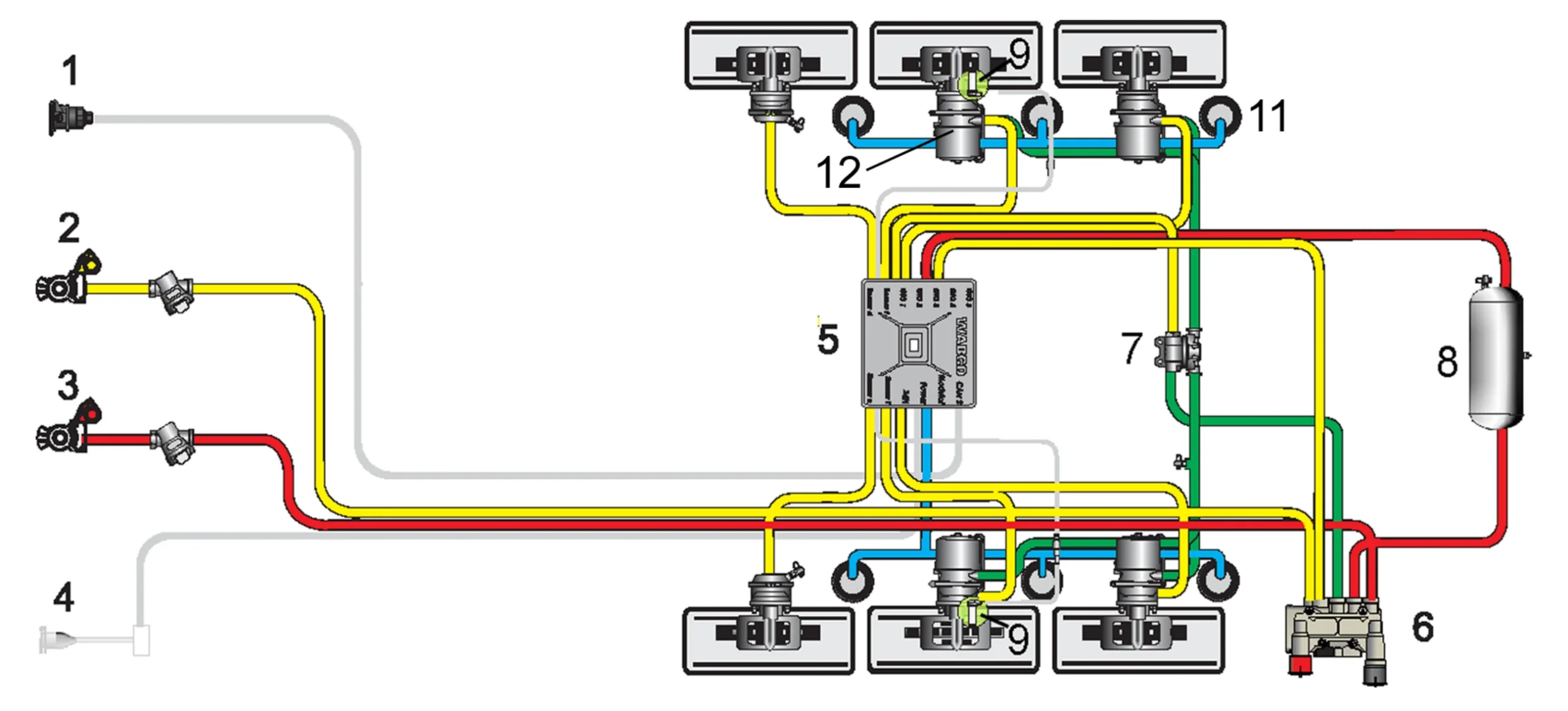
    Schematic diagram of a semi-trailer 2S/2M Anti-lock Braking System showing two wheel speed sensors and two pressure modulators configuration
    Fig 2: Typical Semi-Trailer 2S/2M ABS System Schematic
    1. ISO 7638 Power Supply 2. Service Line 3. Supply Line 4. Stop Light Power (ISO 1185, Optional) 5. TEBS Modulator (with pressure sensors) 6. Park Release Emergency Valve (PREV) 7. Overflow Valve 8. Service Brake Reservoir 9. ABS Speed Sensor 11. Suspension Air Bag 12. Spring Brake Chamber
    ⚠️ Expert Tip: Trailer ABS is designed to prevent loss of directional control, not necessarily to shorten braking distance. For long-wheelbase, high-center-of-gravity trailers, it is the absolute minimum safety requirement.

    2. RSS — The Rollover Prevention Guardian

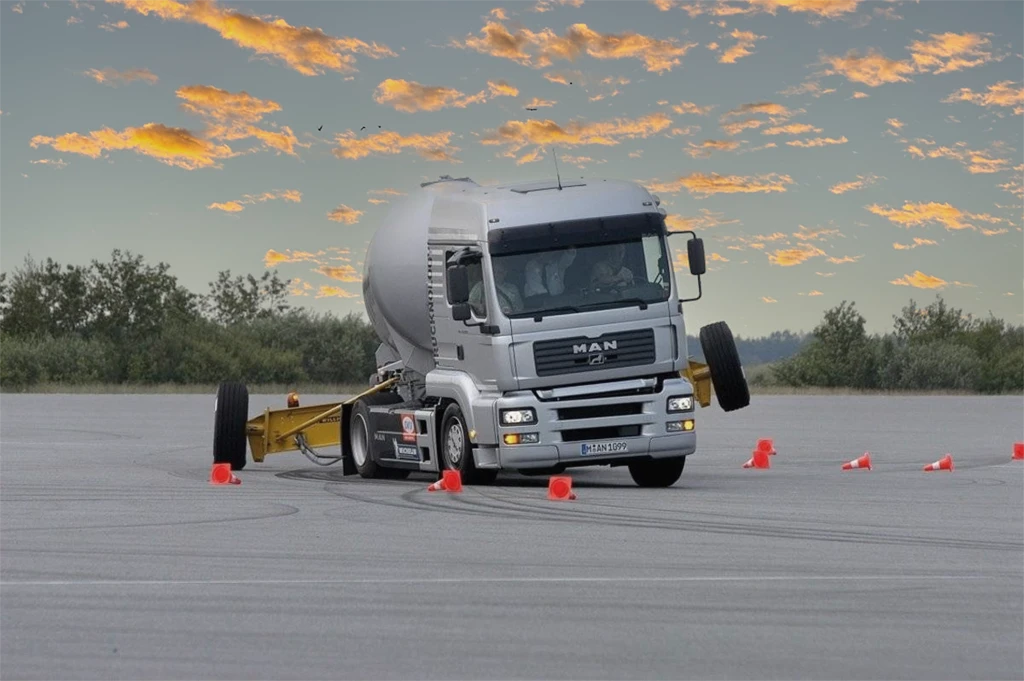
    Roll Stability Support (RSS) is the most critical active safety system for trailers carrying high-risk loads. Different manufacturers use different names, but the core objective is identical — preventing trailer rollover by detecting lateral forces and automatically applying targeted braking:

    • RSS (Roll Stability Support) — ZF / WABCO
    • RSP (Roll Stability Program) — Knorr-Bremse
    • RSC (Roll Stability Control) — Haldex

    Why Do Trailers Roll Over?

    According to the ECE R111 standard, rollover becomes a critical risk when lateral acceleration reaches approximately 0.4G. For trailers carrying liquids, hanging meat, or unevenly distributed loads, this threshold is significantly lower due to dynamic load shifting.

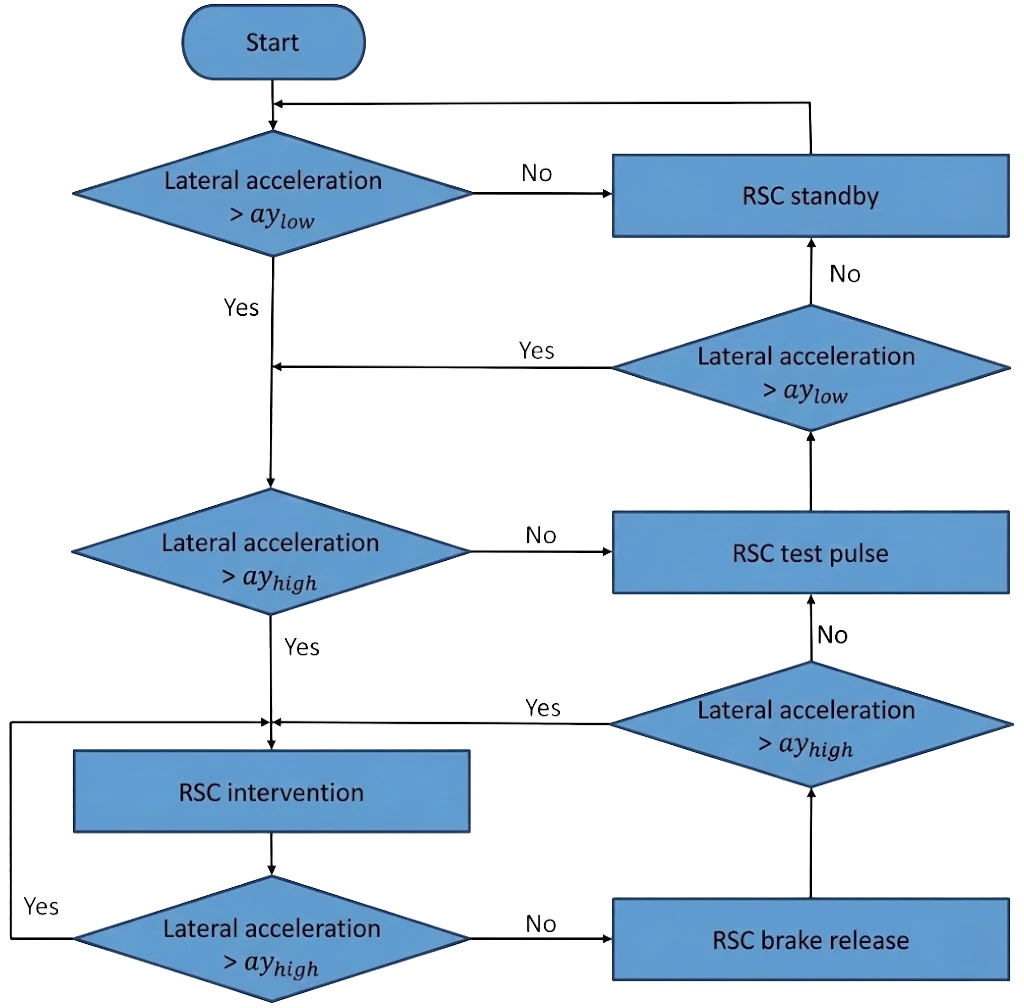
    Kales Trailer Roll Stability Control Logic Diagram showing the intervention flow from lateral force detection to automated brake application
    Fig 3: RSS Logic — The system actively applies brakes to specific wheels to counteract rollover forces.

    How RSS Reacts Faster Than a Human Driver

    RSS relies on physics sensors and algorithms — not driver reaction time. Here are the two mainstream working approaches:

    🔵 WABCO RSS — 3-Stage Intervention

    • Stage 1 (Warning @ ~0.2G): Light braking (~2 bar). Tests wheel grip and pre-charges the system — not intended to decelerate.
    • Stage 2 (Intervention @ ~0.3G): If lateral force increases, the system brakes hard to forcibly reduce speed.
    • Stage 3 (Correction): Higher brake pressure on inner-curve wheels prevents abrupt straightening, guiding the trailer through the turn.

    🟠 Knorr RSP — Smart Pulse Logic

    Test Pulse: When rollover risk is detected, the system sends a micro brake signal to check if the inner wheels decelerate.

    If wheels respond → they have grip. If they do NOT slow down → the wheels are lifting off the ground, confirming high risk. The system immediately applies full emergency braking.

    Critical Warning for Fleet Operators

    🚨 RSS Activation = Near Miss Event

    If the driver feels the trailer “tugging” back, or telematics reports an RSS activation, take it seriously:

    • Without this system, the vehicle would likely have rolled over.
    • It signals dangerous driving behavior (excessive cornering speed) or improper load distribution (center of gravity too high).
    • Mandatory Check: Frequent activation increases component wear. Always inspect brake linings and suspension systems after events. For mountain routes, also review our guide to brake fade on long downhill routes.

    !– ===== SECTION 3: EBS ===== –>

    3. EBS — Making Braking Fast, Precise, and Smart

    EBS (Electronic Braking System), also known as Brake-by-Wire, is not a single function — it is a comprehensive electronic control platform. EBS integrates sensors, actuators, and digital communication, often linking deeply with the trailer’s air suspension system to create a unified chassis management solution.

    When EBS is specified together with air suspension and matched heavy-duty trailer axles, the trailer can achieve more stable braking, better axle load control, and lower tire wear on export routes.

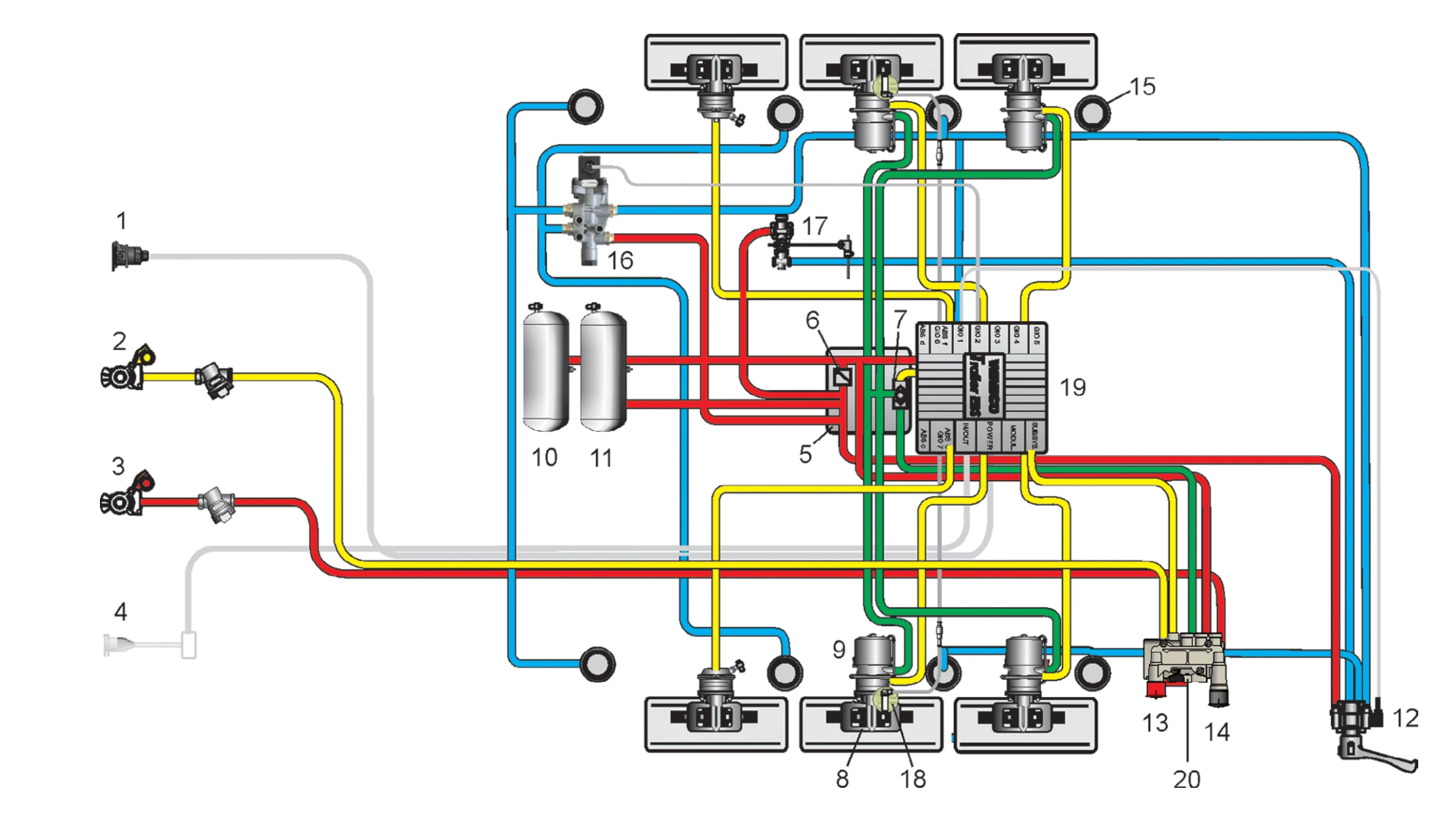
    Schematic diagram of a semi-trailer Electronic Braking System (EBS) integrated with air suspension control, showing modulator positions, sensor locations, and pneumatic circuit layout
    Fig 4: EBS System Schematic Integrated with Air Suspension
    1. ISO 7638 Power 2. Service Line 3. Supply Line 4. Stop Light (Opt.) 5. PEM 6. Overflow Valve 7. Charging Valve 8. Service Brake 9. Spring Brake Chamber 10. Service Reservoir 11. Air Suspension Reservoir 12. Raise/Lower Valve 13–14. Park/Release Buttons 15. Air Bag 16. Lift Axle Valve 17. Levelling Valve 18. ABS Sensor 19. TEBS Modulator 20. PREV

    From Pneumatic Delay to Digital Precision

    Traditional air brakes rely on the foot pedal to physically control air flow through long pneumatic lines — introducing significant delay. EBS replaces this with a pedal position sensor that reads the driver’s braking intent digitally. The ECU calculates required brake pressure for each axle based on speed, load, and wheel speed, then transmits commands via CAN Bus to Electro-Pneumatic Modulators (EPM) located near each wheel.

    Hidden Benefits: Why EBS Is More Than Fast Braking

    Modern EBS platforms (including systems configured by Kales Vehicle) use modular designs integrating the ECU, sensors, and pneumatic control into compact components that simplify chassis layout.

    🔍 The “Invisible Bonuses” of EBS

    • Coupling Force Control (CFC): Optimizes braking timing between tractor and trailer, preventing dangerous “trailer push” or “tugging” sensations.
    • Brake Blending: Intelligently distributes deceleration between endurance braking (retarders) and service braking (pads), extending component life.
    • Lining Wear Control: Automatically adjusts force distribution across axles to ensure even brake pad wear, reducing fleet maintenance costs.
    • Multi-Function Integration: Modern EBS modules integrate Lift Axle Control (LAC), RSS, TPMS, and overflow valves — eliminating complex external plumbing.

    ABS vs EBS: Head-to-Head Comparison

    Feature Traditional ABS (Pneumatic) Smart EBS (Electronic)
    Signal Transmission Air Pipes (Slow) CAN Bus Digital Signal (Near-Instant)
    Response Delay 0.3 – 0.6 Seconds ≈ 0 Seconds
    Core Functionality Anti-lock Only Anti-lock + Wear Balance + Coupling Control + Lift Axle
    AEBS Compatibility Poor (pneumatic lag) Full (zero-delay response)
    Maintenance Insight None Real-time diagnostics & wear data via telematics

    4. AEBS Synergy — The Danger of “Lag”

    AEBS (Advanced Emergency Braking System) decisions are made by the tractor’s radar and camera — but the trailer’s execution capability determines whether those decisions actually save lives.

    ❌ Trailer with ABS Only

    When the tractor triggers AEBS emergency braking, the ABS-only trailer reacts with a 0.3–0.6 second pneumatic lag. The trailer’s massive inertia pushes the tractor forward — extending braking distance and creating a dangerous “Pushing Effect” that can cause jackknifing or loss of control.

    ✅ Trailer with EBS

    The trailer receives the braking signal via ISO 11992 / ISO 7638 interface instantly. It applies full braking force with zero delay, creating a “Stretching Effect” that keeps the entire vehicle combination straight and stable throughout the emergency stop.

    5. The Pyramid of Trailer Intelligent Braking

    Semi-trailer braking technology follows a clear hierarchy. Each level builds on the one below it:

    L3 · ADVANCED

    RSS + AEBS

    Active Rollover & Collision Prevention

    L2 · PLATFORM

    EBS

    Electronic Brain · CAN Bus · Integrated Control

    L1 · FOUNDATION

    ABS

    Anti-Lock · Legal Baseline · Mandatory Standard

    Fig 5: Hierarchy of Semi-Trailer Intelligent Braking Technology

    Export buyer note: specify braking by route risk, not by brochure level

    For African export fleets, port corridors, mining roads and long downhill routes create different braking risks. A flatbed on short paved routes may start with ABS, but tankers, container chassis, dump trailers, high-center cargo and mountain corridors should be evaluated for EBS plus RSS/RSP. The higher system cost is easier to justify when one rollover, jackknife or thermal-fade incident can stop a fleet for days.

    The practical purchasing question is not “ABS or EBS?” but “Can the tractor power and communicate with the trailer system every day?” A missing or damaged ISO 7638 cable, incompatible tractor ECU, poor air quality, wrong sensor gap, contaminated connectors or mixed axle specification can make an advanced system behave like a basic system.

    6. Advice for Fleet Managers and Buyers

    As a professional trailer manufacturer, Kales Vehicle recommends considering the following when specifying braking systems:

    ① Think Long Term: Choose EBS + RSS

    If your fleet operates liquid tank trailers, livestock carriers, or high-value cargo trailers, we strongly recommend EBS with RSS. While the initial cost is higher, preventing a single rollover or jackknife accident pays for the upgrade many times over — in vehicle damage, cargo loss, insurance claims, and human cost.

    ② Never Ignore the ISO 7638 Cable

    🔌 A Fatal Blind Spot for Drivers

    The trailer’s ABS/EBS must be powered and communicate via the ISO 7638 coiled cable — the thickest connector between tractor and trailer.

    If unplugged or damaged, even the most advanced EBS becomes “brain dead” — reverting to basic pneumatic braking with zero anti-lock, zero anti-rollover protection. Always check before every trip.

    ③ Verify Tractor-Trailer Compatibility

    When purchasing, confirm the spec sheet states “EBS Supported” and “RSS/RSP Functionality.” Even if your tractor is equipped with the latest AEBS system, an outdated trailer braking system will compromise the safety of the entire rig. Read our tractor-trailer matching guide →


    Brake Release Gate: ISO 7638, Warning Lamps and First-Trip Diagnostics

    A trailer braking specification is not complete when the purchase order says ABS, EBS or RSS. It is complete only after the tractor, trailer, cables, sensors and diagnostics prove they work as one system. Treat this as a release gate before the first loaded dispatch and after any brake, axle, suspension or wiring repair.

    The evidence supports a strict gate. UNECE Regulation No. 13 frames braking performance and compatibility, ISO 7638 defines the tractor-trailer electrical connector family, and CVSA Brake Safety Campaign Results continue to show how often brake defects remove commercial vehicles from service.

    • Power and communication: connect ISO 7638, inspect pins and cable strain relief, and confirm the ABS/EBS warning lamp proves out then clears.
    • Wheel-end signals: inspect sensor position, tone ring condition and cable routing near axles, air suspension arms and moving brake components.
    • Air and response: check reservoir pressure recovery, audible leaks, modulator response and a low-speed progressive brake test before loading.
    • Diagnostics: save or clear fault codes with the correct tool, then record tractor ID, trailer ID, route risk and corrective action in the maintenance file.

    For fleet practice, connect this release gate with the semi-trailer troubleshooting guide and the Kales maintenance manual. A warning lamp, missing ISO cable or slow trailer response is a repair item, not a driver preference.

    7. Frequently Asked Questions

    Q: What is the difference between ABS and EBS on a semi-trailer?
    ABS prevents wheel lock-up using pneumatic control with electronic monitoring. EBS replaces pneumatic signal transmission with digital CAN Bus signals, reducing response delay from 0.3–0.6 seconds to near zero. EBS also integrates coupling force control, brake blending, lining wear management, and lift axle control — making it a complete electronic braking platform.
    Q: Does my semi-trailer need RSS (Roll Stability Support)?
    RSS is strongly recommended for tank trailers, livestock carriers, and any trailer with high or shifting center of gravity. Per ECE R111, rollover risk becomes critical at ~0.4G lateral acceleration — easily reached during highway curves. For liquid cargo with sloshing dynamics, the threshold is even lower.
    Q: Can a trailer with only ABS work with a tractor equipped with AEBS?
    Yes, but with significantly reduced effectiveness. The ABS-only trailer responds with a 0.3–0.6 second pneumatic delay, causing a “pushing effect” that extends braking distance and risks jackknifing. An EBS-equipped trailer receives signals instantly and brakes with zero delay.
    Q: What happens if the ISO 7638 cable is disconnected?
    The trailer’s ABS and EBS systems lose both power and communication. The trailer reverts to basic pneumatic braking with no electronic safety features — no anti-lock, no roll stability, no coupling control. This is a critical safety hazard. Always check the connection before departure.
    Q: Is EBS worth the extra cost for fleet operations?
    Yes. EBS reduces brake response time to near zero, extends brake pad life through intelligent wear balancing, and supports coupling force control for smoother combined braking. Preventing a single serious accident typically saves more than the cost of equipping an entire fleet with EBS.

    Safety Is the Biggest ROI

    In the era of intelligent transport, the trailer is no longer a silent partner. Don’t just compare volume and price — ask: “Is the braking system smart enough?”

    Kales Vehicle provides the safest, most durable semi-trailer solutions for global clients.

    Get a Custom Braking System Quote →

    Or message us on WhatsApp

    Need help applying this guide?

    Share your trailer type, payload, routes, operating climate, and photos with Kales. Our team can review the key points from this guide and recommend a practical specification for your fleet.

    1. Send photos of your tractor, trailer, or current component layout
    2. Confirm payload, road conditions, gradients, climate, and duty cycle
    3. Receive a specification or maintenance recommendation within 24 business hours

    Email: [email protected]  |  WhatsApp: +86 131 5638 8843  |  Request a quote

  • How Trailer Aerodynamic Upgrades Deliver Over 10% in Fuel Savings

    How Trailer Aerodynamic Upgrades Deliver Over 10% in Fuel Savings

    Last updated: May 2026 | Published: October 14, 2024

    Lead Engineer at Kales

    Reviewed by Jason M.
    Lead Fleet Maintenance Engineer, Kales Vehicle

    💡 Executive Key Takeaways:

    • Fuel Cost Impact: Aerodynamic drag represents over 50% of a tractor-trailer’s energy consumption at highway speeds (>50 mph / 80 km/h).
    • Tested ROI: Combined deployment of Side Skirts, Boat Tails, and Gap Fairings reduces Cd (drag coefficient) to yield over 10% in fleet fuel savings.
    • Durability Engineering: Kales side skirts utilize flexible TPU/PP composite materials that bend up to 90° without cracking on rough terrains.

    What are trailer aerodynamic devices? Trailer aerodynamic devices are engineered hardware components designed to reduce wind resistance (drag) on commercial semi-trailers. The five primary devices include Side Skirts, Boat Tails, Gap Fairings, Wheel Covers, and Vented Mud Flaps. By streamlining airflow around the vehicle’s largest flat surfaces, these verified technologies collectively lower overall fuel consumption by 1% to over 10%.

    Running a profitable logistics fleet means constantly battling rising diesel prices. While standard maintenance—like ensuring proper tire pressure—is essential, it is often not enough to protect your margins. To truly maximize efficiency, you need to address the invisible enemy draining your fuel tank: Aerodynamic Drag. At highway cruising speeds, aerodynamic drag accounts for over 50% of the tractive energy required by a Class 8 tractor-trailer. Streamlining this profile directly translates into substantial cost savings and optimized fleet operations.

    The Data-Driven Savings Comparison

    Based on rigorous testing by organizations like the North American Council for Freight Efficiency (NACFE) and EPA SmartWay, here is the proven fuel economy impact of each component:

    Device Primary Function Proven Fuel Savings Source / Evidence
    Side Skirts Smooths under-trailer airflow 1% – 5% NACFE Reports
    Boat Tails Mitigates rear suction zone 3% – 5% NACFE Reports
    Gap Fairings Bridges tractor-trailer gap 2% – 4% NACFE Reports
    Wheel Covers Reduces wheel dish turbulence 1% – 3% Fleet Tests
    Vented Mud Flaps Allows high-speed air pass-through 1% – 2.7% EPA SmartWay

    Deep Dive: The 5 Essential Aero Upgrades

    1. Aerodynamic Side Skirts (The Industry Standard)

    Side skirts are the foundation of trailer aerodynamics, proven by NACFE to be the most widely adopted and mathematically effective drag-reducing device. By hanging panels on both sides of the chassis, they prevent high-speed wind from rushing underneath the trailer to hit complex axles, brake drums, air lines, and crossmembers.

    To withstand harsh operational environments, modern Kales side skirts are engineered using advanced thermoplastic polyurethane (TPU) or glass-reinforced polypropylene (PP) composite panels. These materials possess high impact resistance and structural memory, allowing them to flex up to 90 degrees when scraping over obstacles like railroad crossings, curbs, or unpaved terrain, and snap back to their original shape without cracking.

    📈 Kales Fleet Data: A logistics partner running 50 Kales curtain siders equipped with aerodynamic side skirts verified a 4.2% fuel reduction over 100,000 highway miles.
    China Manufacturer Curtain Side Trailer with Aerodynamic Side Skirts for Sale
    Figure 1: Kales Curtain Sider equipped with side skirts to smooth undercarriage airflow.

    2. Trailer Boat Tails (Rear Fairings)

    Boat tails successfully dissolve the massive low-pressure vacuum effect—often called “suction drag”—created at the flat rear of traditional dry vans and boxed trailers. Tapering the exiting airflow significantly curtails this backward pull.

    According to aerodynamic physics, air flowing over the trailer boundary layer separates at the rear, creating a low-pressure wake that acts like a physical tether pulling the vehicle backward. Installing high-quality rear fairings or trailer tails stabilizes this wake, reducing the drag coefficient ($C_d$) by up to 5%. Rigorous testing under SAE J1321 Type II fuel consumption procedures confirms that three-sided or four-sided boat tails yield a highly cost-effective fuel economy improvement.

    Heavy Duty Dry Van Trailer with Boat Tail Aerodynamic Kit
    Figure 2: Boat Tails reduce the low-pressure suction zone at the rear.

    3. Nose Cones & Gap Fairings

    Gap fairings smoothly tackle the highly turbulent open space resting between the truck cab (tractor) and the flat face of the trailer. When wind gets trapped in this gap, it brutally slams into the trailer’s “headboard” (front bulkhead) to act as an invisible brake.

    This turbulence is especially severe when the tractor-to-trailer gap exceeds 30 inches (76 cm). Incorporating a three-dimensional dome nose cone or cab side extenders guides the boundary layer airflow smoothly from the tractor roof and sides over the front edges of the trailer, bridging the gap and reducing drag by 2% to 4%.

    Gap Fairing installed on Kales Dry Van Trailer for fuel efficiency
    Figure 3: Gap Fairings bridge the space between the tractor and trailer.

    4. Aerodynamic Wheel Covers

    Aerodynamic wheel covers effectively halt the heavy churning turbulence generated inside the deep, irregular metal dishes of commercial rims. By constructing a completely flat rotating surface, these highly cost-effective hubcaps stop wind from becoming trapped altogether.

    This suppresses vortex shedding around the dual tire assemblies. To ensure long-term reliability on highway routes, Kales wheel covers feature patented anti-theft, anti-loosening mounting brackets that secure them firmly to the wheel hub, preventing detachment from high rotational forces and vibrations. Independent fleet testing has definitively recorded cumulative fuel savings resting between 1% and 3% when these covers are applied fleet-wide over the various axles.

    5. Vented Aerodynamic Mud Flaps

    Vented mud flaps are a simple fix to the intense drag penalty caused by standard solid-rectangular flaps that catch headwinds like miniature parachutes at highway speeds.

    By using a slotted, open-matrix design, these flaps allow high-speed airflow to pass directly through them, lowering drag without sacrificing debris-shielding and water-spray suppression capabilities. Exhaustive testing by Exa Corporation and official EPA SmartWay verifications confirm a solid fuel economy uptick ranging from 1% to 2.7% natively from this upgrade, making it an extremely quick payback accessory for long-haul operations.

    Vented Aerodynamic Mud Flaps for Semi Trailers Factory Direct
    Figure 4: Vented mud flaps allow air to pass through, reducing drag.
    📌 Transparency & Operational Variables:
    While aerodynamic devices offer proven mathematical savings, actual fuel economy is highly dependent on operational variables. Aerodynamic drag becomes a primary fuel consumer only at highway speeds exceeding 50 mph (80 km/h). Under the aerodynamic drag equation:

    F_d = 1/2 * ρ * v2 * C_d * A

    where ρ represents air density, v represents vehicle velocity, C_d is the drag coefficient, and A is the frontal area. Because velocity is squared, aerodynamic drag grows exponentially at higher speeds. Conversely, severe crosswinds, aggressive driver acceleration, and improper tire pressure can negate these aerodynamic benefits.

    Specification Checklist Before Ordering Aero Devices

    Before ordering an aerodynamic package, the fleet should record the tractor model, trailer height, tire size, suspension type, fifth wheel height, typical payload, average cruising speed, and the percentage of loaded versus empty mileage. These inputs decide whether a side skirt, boat tail, nose cone, or gap fairing will work as expected. A device designed for a high-cube van trailer may not fit a flatbed, lowbed, tanker, or dump trailer without changing brackets, ground clearance, and maintenance access.

    The second check is damage risk. Export fleets often work across paved highway, gravel yards, construction entrances, border queues, and port loading areas in the same week. If drivers frequently reverse against docks, cross deep ruts, or operate where road debris strikes the lower trailer edge, the aero package should prioritize flexible materials, replaceable panels, reinforced mounts, and easy removal. A small reduction in peak fuel saving is acceptable if it prevents repeated panel damage and keeps the trailer available for work.

    The third check is measurement. Fuel savings should be compared before and after installation using the same route, similar payload, similar speed range, and corrected tire pressure. Without this baseline, a fleet may blame the aero device for poor results when the real causes are headwind, underinflated tires, aggressive acceleration, engine idling, or brake drag. A reliable test period normally needs enough trips to average out wind, weather, driver variation, and loading differences.

    Finally, specify the aero package together with the maintenance plan. Mechanics need clear access points for brake chambers, ABS wiring, air lines, suspension hangers, tire valves, and landing gear. The best long-term configuration is the one that saves fuel while still allowing fast roadside inspection, because a trailer that cannot be inspected easily will lose more money through downtime than it saves through drag reduction.

    Route-Fit ROI: When Aero Upgrades Pay Back

    Aerodynamic trailer upgrades should be specified after the route is understood, not only after looking at a catalog photo. They produce the strongest fuel return on steady highway work where the tractor-trailer spends long periods above 50 mph or 80 km/h, because aerodynamic drag rises with the square of speed. In stop-start port shuttle work, short quarry trips, and low-speed urban delivery, the same devices may still improve splash control and fleet image, but the fuel ROI is usually weaker.

    For export fleets in Africa, Central Asia, and mixed highway/off-road work, the engineering choice is a balance between drag reduction and service access. A side skirt that saves fuel but blocks daily tire, brake, air-line, and suspension inspection can create a maintenance problem. KALES therefore treats quick-release panels, ground clearance, bracket strength, and mud-resistance as part of the aerodynamic specification, not as secondary details.

    Good fit

    Long highway mileage, stable cruising speed, high annual fuel spend, trained drivers, and scheduled maintenance that protects the aero devices.

    Weak fit

    Low-speed routes, frequent dock impact, rough off-road sections, poor tire-pressure discipline, and trailers that need daily underbody access.

    Related KALES guides

    Fuel efficiency program | Tire cost and retreading | Trailer maintenance manual | ABS/EBS braking guide | KALES trailer categories

    Evidence references

    Our Final Recommendation

    Aerodynamic trailer devices are no longer optional “nice-to-haves” for heavy-duty transportation; they are calculated necessities meticulously designed to expand your hauling margins. Separately, upgrades like side skirts and boat tails offer peak fuel savings upward of 5%. Symmetrically combining the full spectrum of these aerodynamic elements effectively safeguards a compounding fleet-wide fuel reduction well over 10%.

    Because side skirts and advanced aerodynamics drastically alter your profitability during highway operations, explore our factory configurations directly. Check out our Kales Semi-Trailers, specifically engineered and custom-fitted for ideal geometric drag-reduction.

    Frequently Asked Questions

    What is the most effective aerodynamic device for a semi-trailer?

    Side skirts are universally regarded as the most effective starting point, independently providing 1% to 5% fuel savings by protecting the highly turbulent undercarriage of the trailer from wind drag.

    Are trailer boat tails actually worth the investment?

    Yes. NACFE reports indicate that rear wake devices or boat tails systematically deliver a 3% to 5% fuel savings by neutralizing the low-pressure suction zone at the rear doors, affording a very swift return on investment.

    Do vented aerodynamic mud flaps save fuel?

    Absolutely. While standard mud flaps perform like wind parachutes at highway speeds, EPA-verified vented flaps allow the same air to pass straight through, seamlessly generating an efficiency boost spanning 1% to 2.7%.

    Still undecided?

    Don’t guess. Let our engineering team simulate the ideal aerodynamic load configuration for your specific operation parameters.

    Need help applying this guide?

    Share your trailer type, payload, routes, operating climate, and photos with Kales. Our team can review the key points from this guide and recommend a practical specification for your fleet.

    1. Send photos of your tractor, trailer, or current component layout
    2. Confirm payload, road conditions, gradients, climate, and duty cycle
    3. Receive a specification or maintenance recommendation within 24 business hours

    Email: [email protected]  |  WhatsApp: +86 131 5638 8843  |  Request a quote