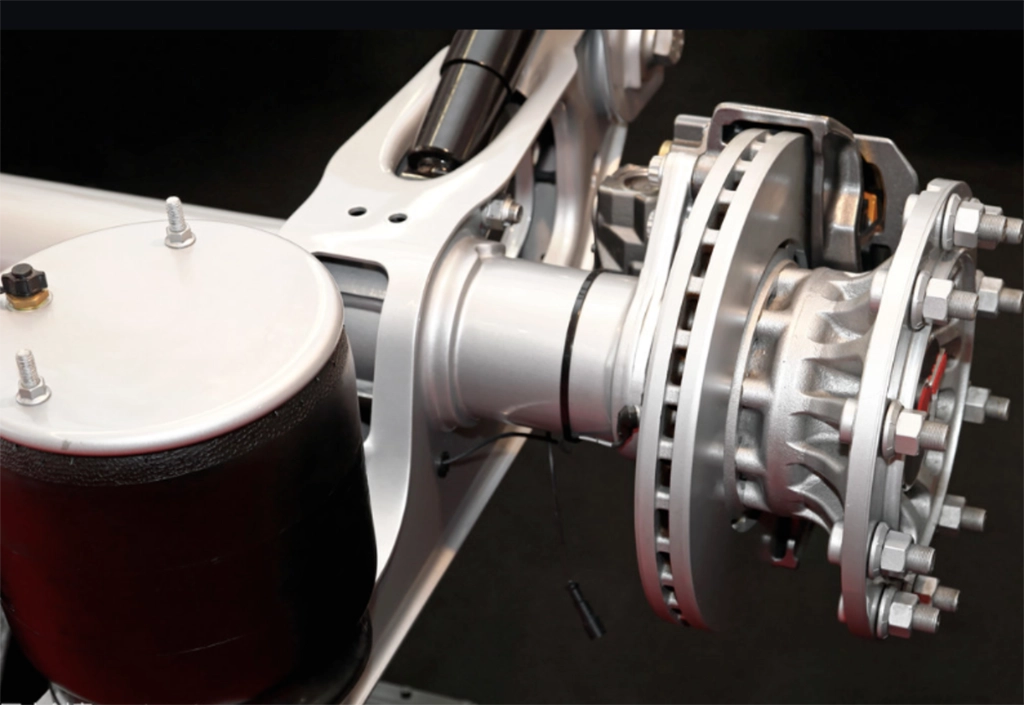
Tag: Truck Safety

  • Disc Brakes vs. Drum Brakes: The Ultimate Guide for Fleets

    Disc Brakes vs. Drum Brakes: The Ultimate Guide for Fleets

    “I heard disc brakes are safer, but they cost thousands more?”
    “Are disc brakes too fragile for heavy loads?”
    “Is the upgrade really worth the investment?”

    In recent years, "Disc Brakes" have become a buzzword in the logistics industry. With stricter international safety regulations, more new trucks and premium trailers are coming standard with disc brakes. However, many fleet owners still have doubts: Are they really that good? Or are they just an expensive trend?

    Today, we provide a no-nonsense, technical breakdown. We will clarify the advantages, disadvantages, and determine if this investment is worth your money.


    1. What is the Difference? "Clamping" vs. "Expanding"

    To understand which is better, we must look at how they work.

    🛠️ Drum Brakes: The Classic Standard

    The brake drum rotates with the wheel. When braking, internal pistons push the brake shoes outward to rub against the inner wall of the drum.
    Features: Low cost and traditional design. Because brake shoes are durable and provide high braking torque at the same diameter, they remain the top choice for heavy-duty off-road transport.
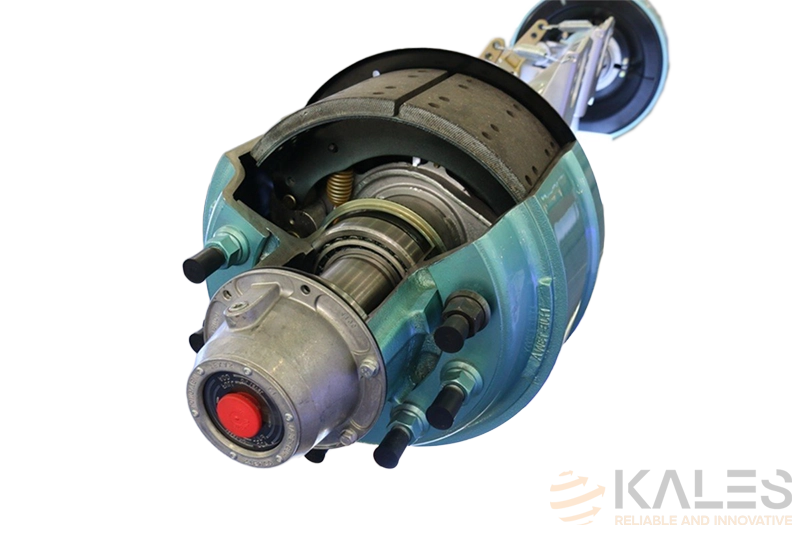
    Kales American-type 13-ton drum brake semi-trailer axle for heavy-duty transport

    ⚙️ Disc Brakes: The Modern Standard

    The brake disc (rotor) rotates with the tire. When braking, the caliper clamps the brake pads against the disc from both sides to generate friction.
    Features: Rapid development. They are now standard on dangerous goods transport and high-end logistics vehicles worldwide.
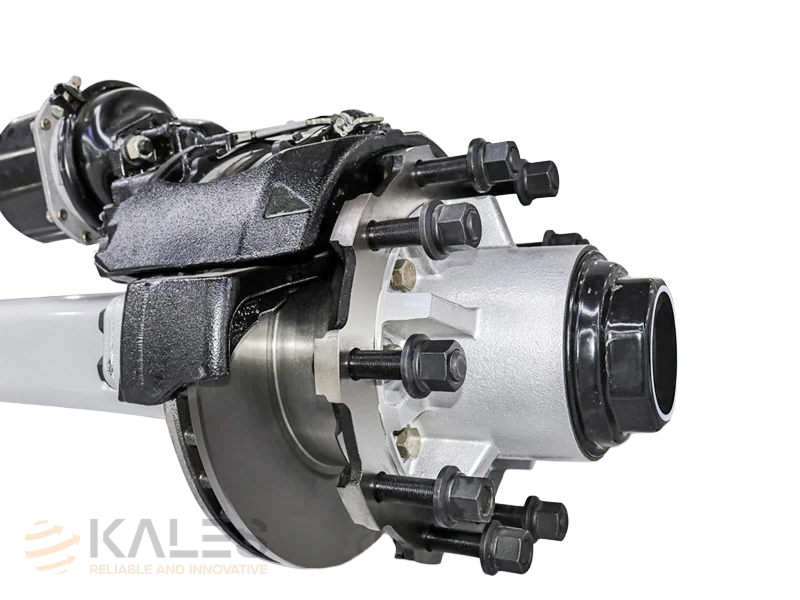
    Kales American-type 13-ton disc brake semi-trailer axle for standard freight trailers


    2. Why Are Regulations Pushing for Disc Brakes? 4 Key Advantages

    Compared to drums, disc brakes offer a quantum leap in safety:

    1. Faster Response (Essential for ABS/EBS)

    Disc brakes respond instantly, allowing for high-frequency braking actions. This makes them perfectly compatible with ABS (Anti-lock Braking System) and EBS (Electronic Braking System). On wet roads, this prevents jackknifing and side-slipping effectively.

    2. Resists "Heat Fading" & Stable Pedal Feel

    Drum Brake Pain Point: Under continuous braking, the drum heats up and expands (diameter increases). The brake shoes can lose contact with the drum surface, causing brake failure (Heat Fade).
    Disc Brake Advantage: Excellent heat dissipation. Even if the disc expands due to heat, it expands in thickness, not away from the pads. Braking force remains stable, and pedal travel does not increase dangerously.

    3. Balanced Braking Force (No Veering)

    Drum brakes have a "self-energizing" effect which can lead to uneven braking force between left and right wheels. Disc brakes provide linear and equal braking force on both sides, keeping the vehicle stable during emergency stops.

    4. Visual Maintenance & Automatic Adjustment

    Disc brakes come with automatic gap adjustment mechanisms, reducing manual labor. Brake pad thickness is visible without dismantling the wheel hub, eliminating "hidden wear" risks.


    3. The Financials: TCO (Total Cost of Ownership) Analysis

    Many truckers are scared off by the initial cost. Let's calculate the real ROI.

    Initial Investment Upgrading a 3-axle trailer to Disc Brakes + Air Suspension
    Approx. cost increase: ~$5,500 USD

    💰 Hidden Profits (ROI):

    1. Weight Savings (More Cargo):
    Disc axles are lighter than drum axles. A 3-axle setup saves about 150kg.

    • 📝 Calculation: Based on 150,000 km/year operation:
    • Extra cargo revenue can amount to ~$1,000+ USD per year.
    • In 3 years, you earn back ~$3,000 USD just on weight.

    2. Maintenance Savings (Less Downtime):
    Faster Changes: Disc pads take 30 mins to change; Drums take half a day. Time is money.
    Tire Life: Disc brakes + Air suspension ensure even tire wear. Saving 20% on 22 tires/year saves at least ~$800 - $1,200 USD/year.

    Conclusion: While the upfront cost is higher, through fuel savings, extra cargo, and tire longevity, you typically break even in 2-3 years, while enjoying superior safety.


    4. The "Enemies" of Disc Brakes: Know the Limitations!

    Disc brakes are advanced, but they require proper usage.

    ⚠️ 1. Lower Absolute Braking Torque

    At the same size, drum brakes provide higher absolute stopping torque. For severely overloaded vehicles, drums are still "stronger."
    Solution: Disc brakes MUST be used with auxiliary braking systems (Retarders/Engine Brakes). Relying solely on friction brakes for heavy loads will wear them out quickly.

    ❌ 2. Fatal Mistake: Thermal Shock (Water Cooling)!

    This is the disc brake's biggest weakness.

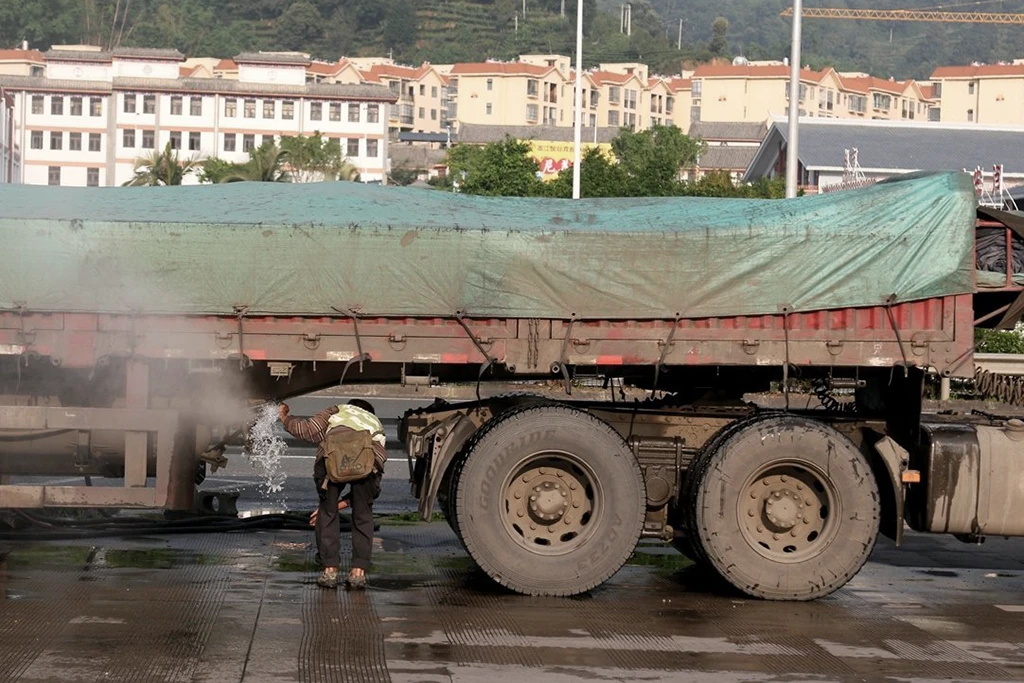
    • Physics (Quenching Effect): Brake discs are cast metal. If a red-hot disc (400°C+) is suddenly sprayed with cold water (a common habit in some regions), it will shrink instantly and crack or shatter.
    • Mud & Dirt: In muddy mining sites, gravel can get trapped in the open caliper, acting like sandpaper. Use drum brakes for construction sites.

    5. Avoid Pitfalls: Matching Tractor & Trailer

    If you feel a "pushing" sensation or "soft brakes," the issue might not be the disc brakes, but a mismatch between the Tractor and Trailer braking systems.

    🚛 Braking System Compatibility Table

    Tractor Config Trailer Config (Disc) Match Effect
    EBS + Disc EBS + Disc ★ Best ★
    ABS + Disc EBS + Disc ★ Best ★
    EBS + Disc ABS + Disc Medium
    ABS + Drum ABS + Disc Poor
    ABS + Drum EBS + Disc ❌ Very Bad ❌

    💡 Expert Note: Mixing an old Drum Brake Truck with a new Disc Brake Trailer often causes response lag. Consult a professional for valve adjustment.


    6. Practical Guide: Daily Use & Maintenance

    1. The 3 Golden Rules

    • 🚫 NO Water Cooling: Do not spray water on hot discs. They will crack.
    • 👀 Visual Check: Inspect the open caliper structure daily for debris or cracks.
    • 💧 Drain Air Tanks: Drain water from air tanks every 2 weeks to protect the valves.

    2. Maintenance Standards

    ⚠️ The Red Line: 2mm

    Kales experts advise: When brake pad friction material wears down to 2mm, replace immediately!
    Also replace if you see: Glazing (shiny surface), Cracks, or Oil contamination.

    🛠️ Axle Maintenance Tip

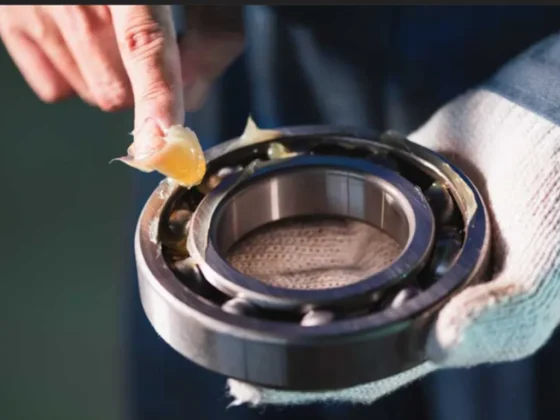
    Axle Care: Don't forget to grease the axle hubs annually.
    💡 Want less hassle? Choose Kales 13-Ton Disc Brake Axles. They come with specialized long-life lubrication, offering longer maintenance intervals and better stability.


    7. Summary: Who Should Switch?

    Should you upgrade? Find your scenario:

    • Highly Recommended: Standard Load Transport, Express Logistics, Dangerous Goods, High-Value Cargo (Electronics/Cold Chain).
    • Use Caution: Severe Overloading, Mining/Off-road sites, or drivers who refuse to use Retarders.

    ❓ FAQ

    Q: How often should I change disc brake pads?
    A: It depends on usage. For standard highway logistics, front axle pads last 100k-150k km, trailer pads 80k-120k km. Using a retarder can extend this to 200k+ km.

    Q: Can I put disc brakes on leaf spring suspension?
    A: Technically yes, but Air Suspension is strongly recommended (and often legally required) with disc brakes to reduce vibration damage to the precise caliper mechanisms.

    Q: I see small cracks on the rotor. Should I change it?
    A: Hairline heat cracks on the surface are normal. However, if cracks extend to the edge or are deeper than 1.5mm, replace the rotor immediately to prevent shattering.

    Need a specific trailer configuration or quote?

    Our team can calculate the TCO for your specific route.
    📱 Chat with Kales Experts (WhatsApp)
  • Kales Trailer Lubrication Guide: Maintenance Schedule & Grease Types

    Kales Trailer Lubrication Guide: Maintenance Schedule & Grease Types

    Proper lubrication is one of the most critical yet often overlooked aspects of Kales semi-trailer maintenance. Regularly greasing the right components with the correct lubricants not only ensures smooth operation but also prevents premature wear, enhances road safety, and significantly extends your trailer’s service life.

    In this guide, we’ll walk you through everything you need to know about lubricating your Kales semi-trailer—from recommended grease types and lubrication intervals to best practices that keep your fleet running efficiently.


    Why Lubrication Matters for Your Kales Semi-Trailer

    Friction is the silent enemy of heavy-duty trailers. Without adequate lubrication, you risk:

    • Accelerated wear on moving parts
    • Heat buildup in axle bearings and joints
    • Component seizure or unexpected failure
    • Reduced fuel efficiency due to increased rolling resistance
    • Increased Safety Risks: Especially in critical systems like brakes and suspension.

    By following a structured Kales semi-trailer lubrication schedule, you protect your investment, reduce repair costs, and avoid costly roadside breakdowns.

    Mechanic applying grease to Kales semi-trailer wheel bearing for maintenance


    Recommended Lubricants for Kales Semi-Trailers

    Kales specifies three primary grease types. Using the correct lubricant is essential. Below is a comparison of the Chinese Standards (found in your manual) and their International Equivalents for global maintenance teams.

    Code Lubricant Name Standard (China) International Equivalent (Ref.) Recommended Use Case
    GZ Calcium-Based Grease ZG-4 NLGI #2 (Calcium) General-purpose, moderate temps, chassis points
    QLZ Automotive Universal Lithium Grease GB5671-85 NLGI #2 (Lithium EP) High-load, multi-point applications (Axles)
    SGZ High-Temperature Grease No. 4 ZN6-4 NLGI #3 (High Temp) High-heat zones (e.g., brake pins)
    ⚠️ Critical Warning: Never mix different grease types (e.g., Calcium vs. Lithium). This can cause chemical incompatibility, leading to grease separation and bearing failure.

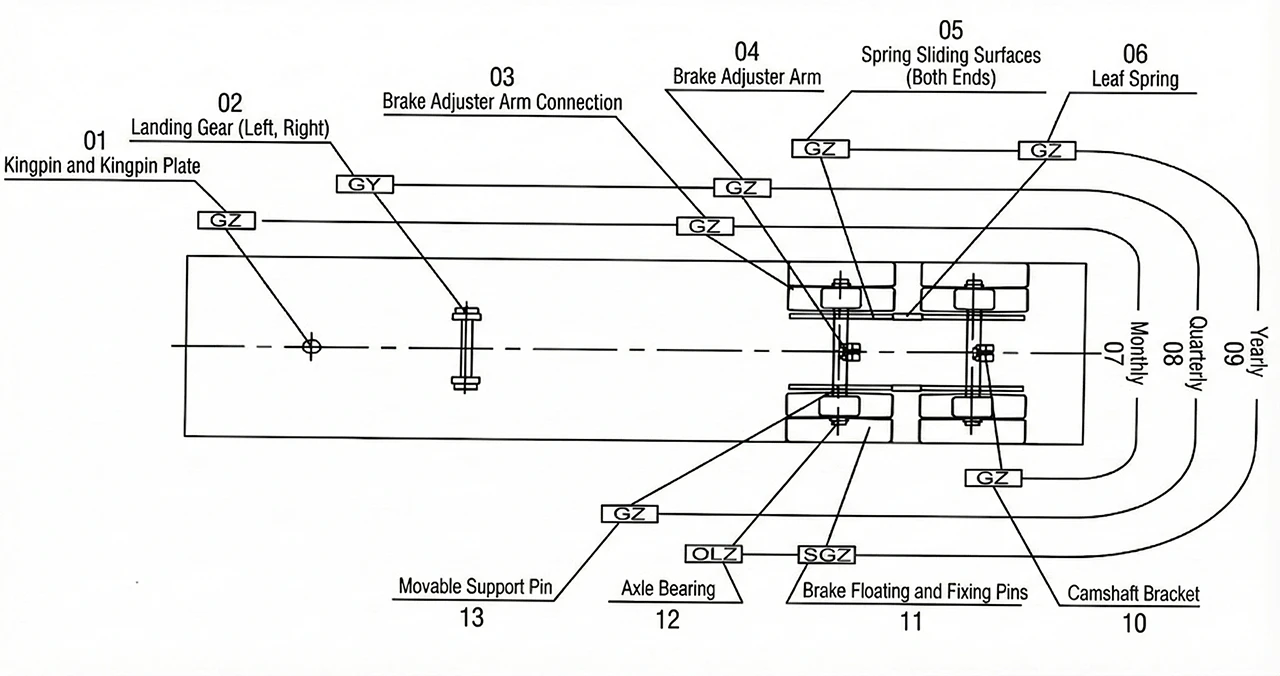
    Kales Semi-Trailer Lubrication Points Diagram showing kingpin, landing gear, and suspension

    Lubrication Points Key:
    01: Kingpin & Plate | 02: Landing Gear | 03-04: Brake Adjusters | 05-06: Leaf Springs & Slides
    10: Camshaft Bracket | 11: Brake Pins | 12: Axle Bearing | 13: Movable Support Pin


    Kales Semi-Trailer Lubrication Schedule

    Below is the official maintenance chart detailing daily, monthly, and annual greasing points.

    Lubrication Frequency Chart

    Lubrication Point Daily Monthly Annually Recommended Lubricant
    Kingpin & Fifth Wheel Plate Calcium-Based (ZG-4 / NLGI #2)
    Landing Gear (Support Device) Calcium-Based (ZG-4 / NLGI #2)
    Brake Slack Adjuster Lithium Grease (GB5671 / NLGI #2 EP)
    Slack Adjuster Linkage Calcium-Based (ZG-4 / NLGI #2)
    Leaf Spring Pins & Slides ✓ (Ends) Calcium-Based (ZG-4 / NLGI #2)
    Brake Camshaft Bracket Calcium-Based (ZG-4 / NLGI #2)
    Axle Wheel Bearings Lithium Grease (GB5671 / NLGI #2 EP)
    Container Twist Lock Pins Calcium-Based (ZG-4 / NLGI #2)
    🔧 Pro Tip: Daily greasing points are typically high-wear components exposed to road debris. Treat these as part of your standard pre-trip inspection.

    Lubrication Best Practices

    ✅ DO:

    • Use clean equipment: Wipe grease fittings (zerks) before attaching the gun to prevent forcing dirt inside.
    • Purge old grease: Apply new grease until you see fresh grease purging from the joint to remove contaminants.
    • Log it: Record all maintenance in your fleet log for compliance and warranty purposes.

    ❌ DON’T:

    • Don't mix grease bases: Stick to one type or thoroughly clean the component before switching.
    • Don't over-pressurize sealed bearings: This can blow out the seals and invite contamination.
    • Don't ignore winter needs: Cold temperatures thicken grease. Ensure your lubricant is rated for your operating temperature.

    Frequently Asked Questions (FAQ)

    How often should I grease the Kingpin on a Kales Trailer?

    The Kingpin and Kingpin Plate are high-friction areas that carry the trailer's weight. Kales recommends greasing these daily or prior to every new coupling to prevent grinding and uneven wear.

    What is the best grease for trailer axle bearings?

    For axle bearings (Point 12), use a high-quality Automotive Universal Lithium Grease (NLGI #2 EP). This resists high temperatures and heavy loads better than standard chassis grease.

    Why do my trailer brakes squeak even after greasing?

    Squeaking can occur if the Camshaft Bracket or Brake Pins are dry. Ensure you verify points 10 and 11 on the diagram. If greased and still noisy, check for worn linings or glazed drums.


    Final Thoughts: Lubrication = Reliability

    For fleet managers and owner-operators, consistent lubrication is non-negotiable. By adhering to Kales’ recommended grease types and maintenance intervals, you ensure driver safety, regulatory compliance, and maximum ROI.

    🔧 Need technical support or spare parts? Contact the Kales Service Team for expert assistance!


  • Preventing Semi-Trailer Brake Fade: How Proper Descents Stop 1,000°F Overheating

    Preventing Semi-Trailer Brake Fade: How Proper Descents Stop 1,000°F Overheating

    Last updated: March 2026

    Lead Engineer at Kales

    Reviewed by Jason M.
    Lead Fleet Maintenance Engineer, Kales Vehicle

    What is semi-trailer brake fade? Brake fade is the dangerous loss of a commercial truck's stopping power during long mountain descents. It occurs when aggressive, continuous braking pushes drum or rotor temperatures past 600°F (325°C), burning away friction limits. By 1,000°F (538°C), linings vaporize and mechanical fade expands the drums outward, resulting in catastrophic failure without warning.

    For even the most seasoned heavy-haul truck drivers, navigating continuous downhill grades remains a high-stakes physics problem. According to Federal Motor Carrier Safety Administration (FMCSA) data, brake-related problems contribute to nearly 30% of all large truck crashes. When transporting an 80,000lb load, downhill margins for error virtually disappear. To ensure the safety of your cargo and protect your commercial asset, drivers must master transmission braking and thermal management.

    The Physics of Downhill Safety

    How temperature escalates into total mechanical failure during continuous braking.

    Brake Temperature Physical Phenomenon Danger Level
    < 400°F (204°C) Normal heat dissipation through drums/rotors. Safe Operation
    ~ 600°F (325°C) Lubricants vaporize; friction coefficient drops rapidly. Warning (Fade Begins)
    1,000°F+ (538°C+) Linings vaporize; extreme heat expands the drum outward away from the shoes. Catastrophic Failure

    The Standardized Safety Process for Mountain Grades

    Truck driver performing pre-trip inspection on brakes before downhill driving
    A thorough inspection of brake pads and air systems is your first line of defense.

    Step 1: The "Pre-Trip Inspection" (PTI) Is Non-Negotiable 🔧

    Before cresting a mountain pass, you must verify the thermal capacity and active tolerance of your foundational components. Vehicles suffering from continuous operation wear are severely jeopardized on 6%+ grades.

    • Brake Clearances: Visually inspect slack adjusters. Brakes slightly out of adjustment heat up faster because other axles must absorb the stopping burden.
    • Air Systems: Bleed the air dryer to ensure zero moisture. Frozen or damp lines severely delay air transfer to the trailer relay valves.
    • Cooling Upgrades: In mining sectors using "brake water spray" cooling systems, ensure maximum water levels and clear nozzles.
    • Tire Degradation: 1,000°F brake heat bleeds directly into wheel rims and tires, elevating blowout risks on defective rubber.
    Truck driver downshifting gear before entering steep downhill slope
    Shift to a lower gear before cresting the peak to maximize engine braking.

    Step 2: Securing the "Right Gear" Strategy ⚙️

    Defensive thermal management begins with the transmission, not the foot pedal. The golden rule for long grades is utilizing lower gears before crossing the peak.

    🛑 The Danger of Neutral Coasting

    Coasting a semi-trailer in neutral is illegal and eliminates critical engine compression resistance. Furthermore, idling RPMs fail to power the air compressor fast enough to replace the massive air volume lost during continuous downhill braking.

    Truck dashboard showing retarder and engine brake indicators
    Utilizing auxiliary braking systems reduces the burden on foundation brakes.

    Step 3: Mastering "Snub Braking"

    "Riding" the brakes with light, continuous pressure acts as an immediate catalyst for glaze and drum expansion. Instead, the official CDL Guidelines mandate the Snub Braking cycle to force intermittent cooling intervals.

    1. Allow the vehicle speed to drift up to your established "safe control speed" (e.g., 40 mph).
    2. Apply service brakes firmly to cut the speed by 5-6 mph in approximately 3 seconds.
    3. Release the pedal completely. This flushes the friction zone with air, bleeding heat off the drum.
    4. Leverage the engine brake/retarder to hold the vehicle until it inevitably creeps back up, then repeat.
    Heavy truck driving in foggy and rainy mountain weather
    Rain or snow drastically reduces tire traction and brake effectiveness.

    Step 4: Weather Adaptation Formulas 🌧️

    Weather severely restricts the braking coefficient of friction on the asphalt. Search data warns that wet roads or icy conditions mandate an immediate drop in baseline downhill speed by at least 1/3 (or 33%). When pairing wet conditions with the "Jake Brake" (engine brake), monitor your drive axles—aggressive engine braking on slick surfaces can trigger a dangerous trailer jackknife.

    📌 Transparency & Operational Variables:
    While mastering Snub Braking drastically reduces the risk of overheating, downhill safety is never absolute. Extreme payload overloading beyond the trailer's rated capacity, undetected mechanical flaws in slack adjusters, or severe black ice can compromise even the best driving techniques. Drivers must always prioritize their company's specific safety manual and the manufacturer's load limits.

    Our Final Recommendation

    Downhill trailer safety relies entirely on avoiding extreme temperatures. A driver using Snub Braking essentially prevents the foundation brakes from breaching the 600°F (325°C) threshold where mechanical friction drop-off begins. Do not ride the pedal, remain in a lowered gear, and maintain your pneumatic lines impeccably.

    Since long-haul safety starts from the ground up, explore our KALES Heavy-Duty Semi-Trailers. Our units are structurally optimized to accommodate integrated high-performance axles and advanced auxiliary braking configurations specifically engineered for safe, loaded mountain descents.

    Frequently Asked Questions

    At what temperature does semi-truck brake fade occur?

    Brake fade initiates as drum temperatures surpass 600°F (325°C), burning away crucial friction lubricants. By the time temperatures escalate to 1,000°F (538°C) or higher, physical expansion forces (mechanical fade) push the drum dangerously out of the brake shoe's reach, leading to total failure.

    What is the "Snub Braking" technique?

    Snub braking is a commercial driving method for descents. Instead of resting a foot on the brake constantly, a driver firmly applies the brakes for about 3 seconds to shave off 5-6 mph from their top safe speed, then completely releases them to allow immediate airflow and cooling before repeating the cycle.

    What percentage of truck crashes involve brake problems?

    FMCSA analyses reveal that brake system issues or failures contribute to approximately 29% to 33% of all large truck accidents, stressing the vital importance of proper downhill heat management and pre-trip inspections.

    Still undecided on the safest trailer configuration?

    Don't guess. Let our engineering team configure the precise braking load parameters for your fleet's mountain operations.