In our previous guide, Disc Brakes vs. Drum Brakes: The Ultimate Guide for Fleets, we discussed the superior safety of disc brakes. But here is the hard truth:
Disc brakes are like high-performance athletes—they need the right equipment to perform. Using them with an outdated suspension or without electronic control is a recipe for premature failure.
For many fleet owners, upgrading the trailer is the smartest, most cost-effective way to improve safety. But if you tick the box for "Disc Brakes," you must also tick the boxes for EBS and Air Suspension.
This isn't an upsell. It's about physics, longevity, and protecting your investment. Here is the technical breakdown from Kales Vehicle experts.
1. EBS: The "Brain" Your Trailer Needs
🛑 Braking Distance Comparison (EBS Disc vs. Conventional Drum)
✅ Vehicles with EBS and Disc Brakes
50 km/h
25m
↓ 5m shorter
80 km/h
45m
↓ 20m shorter!
90 km/h
48m
↓ 27m shorter!
⛔ Vehicles with Conventional Braking & Drum Brakes
50 km/h
30m
80 km/h
65m
90 km/h
75m
Conclusion: The faster the speed, the more obvious the advantage of EBS + Disc Brakes.
At 80km/h, it can save 20 meters of stopping distance, potentially saving lives.
You might think: "My driver is experienced, and my truck has standard air brakes. Why pay extra for Trailer EBS?"
A. The "20-Meter" Safety Gap
Disc brakes bite instantly (0.3s), while pneumatic signals are slow (0.6s+). EBS solves this by transmitting signals electronically.
The Data: Tests show that at 80 km/h, an EBS-equipped vehicle can stop 20 meters shorter than one with conventional brakes. That 20 meters is the difference between a near-miss and a fatal collision.
B. Coupling Force Control (Anti-Jackknife)
EBS manages the "Coupling Force" at the kingpin. Ideally, the force between tractor and trailer should be zero.
Through the ISO 11992 protocol, EBS constantly adjusts the trailer's braking pressure to ensure it neither "pushes" the truck (Jackknife risk) nor "drags" it. This active stability is impossible with standard air brakes.
C. The Hidden Bonus: RSS & Wear Control
🛡️ Roll Stability Support (RSS): Automatically brakes specific wheels to prevent rollover on curves.
💰 Wear Harmonization: EBS sensors monitor pad thickness. It reduces pressure on worn pads and increases it on new ones, ensuring all pads wear evenly. This means you can replace all pads at once, reducing service downtime.
⚠️ Crucial Warning: The ISO 7638 Cable
EBS is useless if it's not plugged in!
We often see drivers connect the air hoses but forget the ISO 7638 Power Cable (the thick 5-pin or 7-pin spiral cable). Without this connection, your premium EBS is dead, and your disc brakes revert to "dumb" mechanical mode.
👉 Action Item: Ensure your tractors have this socket functioning and drivers use it.
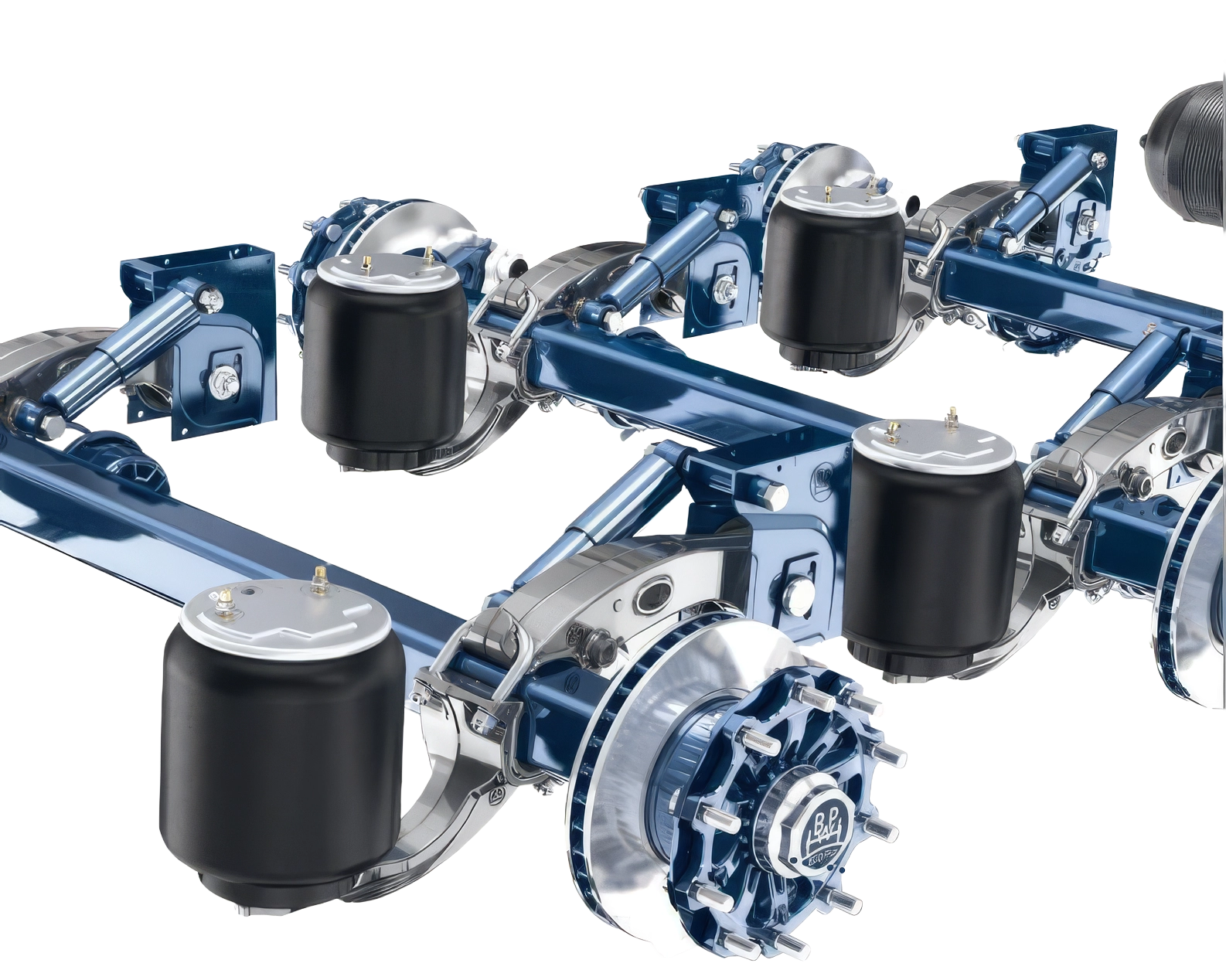
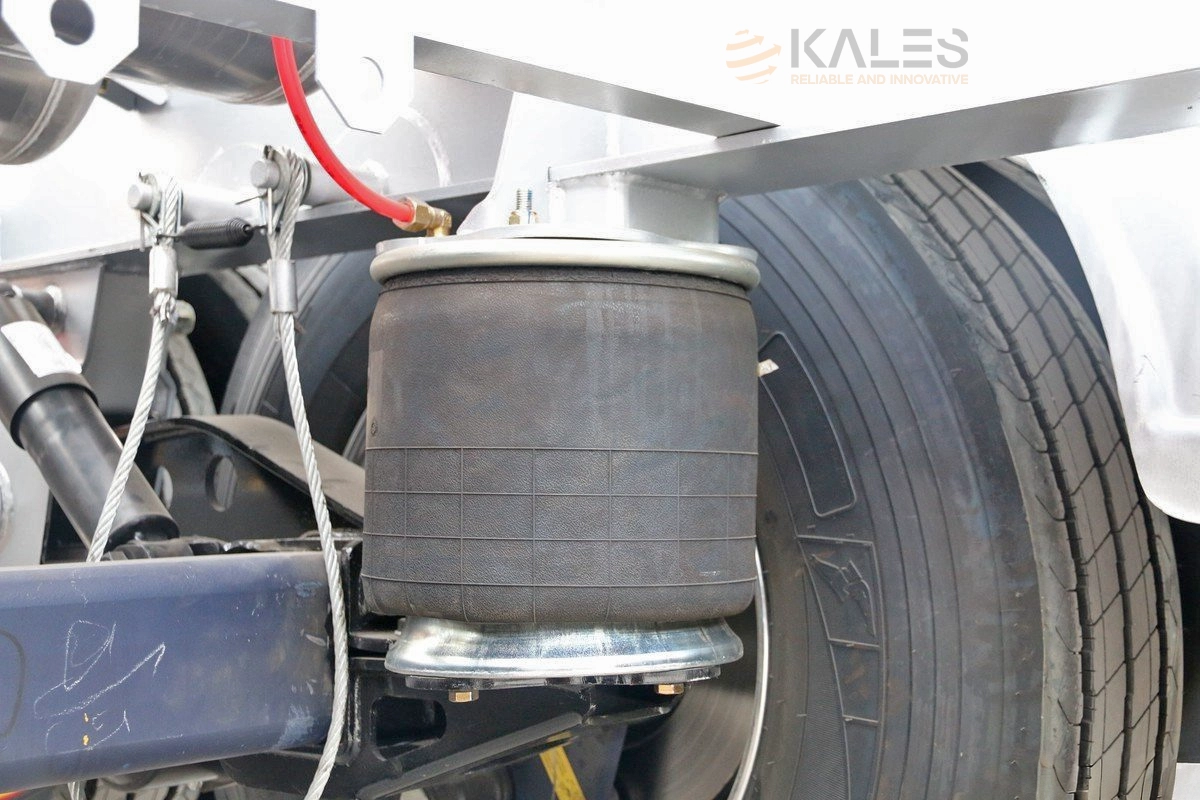
2. Air Suspension: The "Bodyguard" for Calipers
Some buyers think Air Suspension is just for driver comfort. For Disc Brakes, it is a mechanical necessity.
Air suspension filters vibration and ensures constant road contact.
🛡️ 1. Vibration Protection
The Problem: Steel leaf springs transmit harsh road vibrations directly to the axle. This can shake precise caliper mechanisms loose, causing seizing.
The Solution: Air bags act as a damper, filtering out vibrations and extending caliper life.
🛑 2. Eliminating "Wheel Hop"
Physics: When braking hard on a bumpy road, steel springs make the axle "hop." A bouncing tire has zero friction.
The Solution: Air suspension keeps the tire firmly planted on the asphalt, ensuring 100% braking power.
⚖️ 3. Load Equalization
Air suspension instantly equalizes weight across all axles. This ensures no single disc brake is overloaded, preventing rotor cracking due to heat stress.
Summary: Calculate Your ROI
Upgrading your trailer configuration is cheaper than buying a new truck, and it pays for itself.
Feature
The Real Benefit (ROI)
Trailer EBS
1. Shorter Stops: Up to 20m less at 80km/h.
2. Wear Control: Balances pad wear for single-stop maintenance.
3. Stability: Includes Anti-Rollover (RSS).
Air Suspension
Protects sensitive calipers from vibration damage & prevents tire hopping.
ISO 7638 Cable
Free but Critical. Ensure your drivers plug it in!
By choosing Disc Brakes + EBS + Air Suspension, you are building a trailer that is safer, lasts longer, and commands a higher resale value.
Ready to spec your premium trailer?
Don't guess. Let Kales Vehicle experts configure the perfect axle and suspension package for your specific road conditions.
"My tank trailer has EBS; does that mean it brakes automatically?"
"Is standard ABS enough? Why do I need RSS (Roll Stability)?"
"Does the trailer need to support AEBS, or is that just for the tractor truck?"
If you think a semi-trailer is just a "passive metal box" being dragged behind a truck, think again.
In modern intelligent transport systems, the trailer's own safety systems—especially the braking architecture—directly determine whether the entire combination can stop safely, stay stable, or actively avoid accidents in critical moments. As a professional semi-trailer manufacturer, Kales Vehicle is here to walk you through ABS, EBS, RSS, and AEBS, clarifying their relationships, capabilities, and common misconceptions.
1. The Foundation: ABS — Anti-Lock, Steering Control
ABS (Anti-lock Braking System) is currently the mandatory standard for trailers in many regions. Fundamentally, it is an extension of the pneumatic braking system that allows for electronic intervention.
Core Function:During emergency braking, ABS monitors wheel speed to prevent trailer wheels from locking up. Once a wheel locks, the tire loses lateral grip, causing the trailer to slide, swing, or even lead to a catastrophic Jackknife accident.
The image on the right visually compares tire marks under three conditions:
ABS Active: Dotted/intermittent marks, "brake-and-roll", directional control maintained.
Locked-up: Solid dark skid marks, total loss of control.
Fig 1: Tire Mark Comparison: A. Rolling vs B. ABS Active vs C. Locked Wheel
Principle & Advantages:
The driver's braking action is transmitted pneumatically via the foot valve. Wheel speed sensors are installed on key axles (typically 2S/2M or 4S/2M configurations). When the system detects an impending lock-up, the modulator valve rapidly adjusts air pressure, achieving a "rapid pulsing" effect several times per second.
Simple Control Principle: Adds electronic monitoring to traditional air lines. Low cost and easy maintenance.
Foundation for Expansion: This logic forms the hardware platform for advanced functions like ESP (Electronic Stability Program).
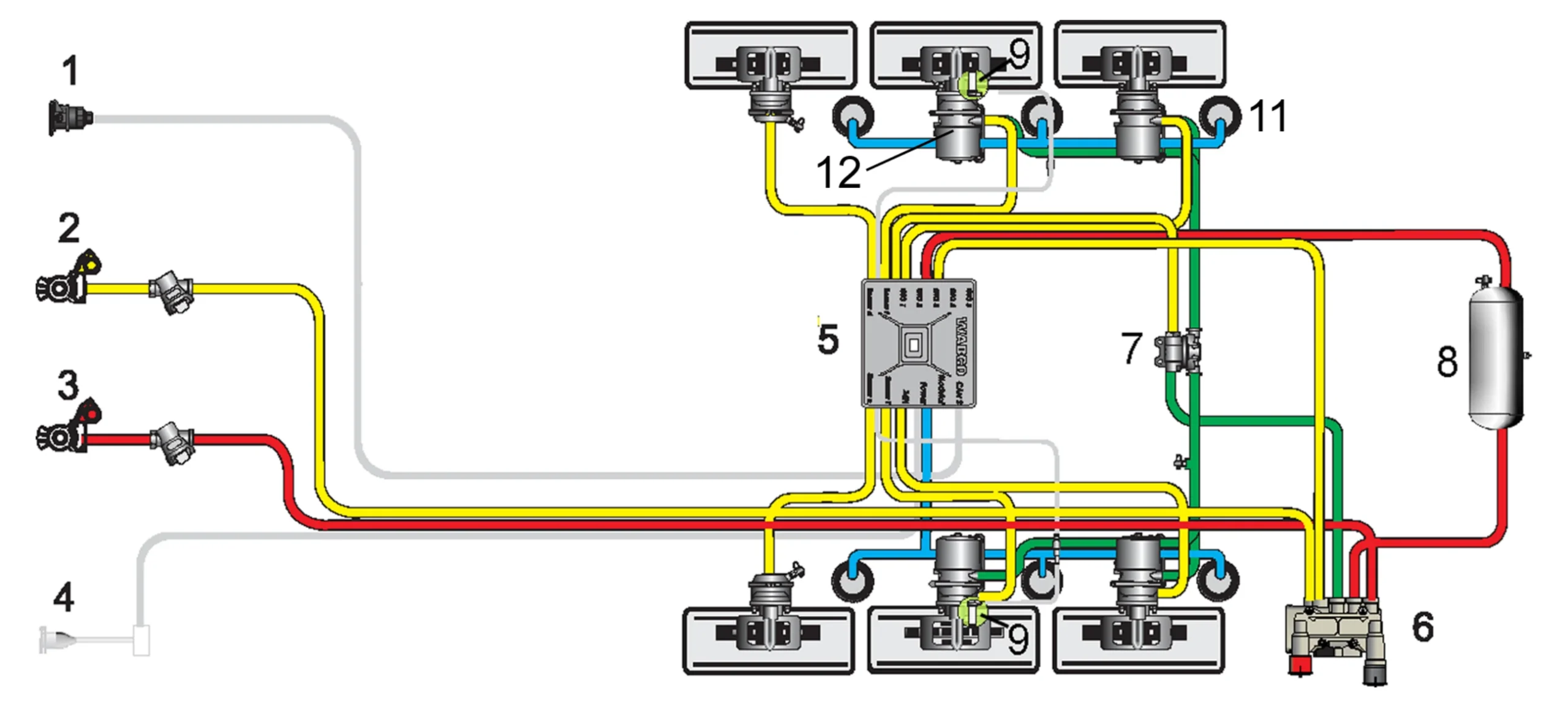
Fig 2: Typical Semi-Trailer 2S/2M ABS System Schematic1. ISO 7638 Power Supply 2. Service Line 3. Supply Line 4. Stop Light Power (ISO 1185, Optional) 5. TEBS Modulator (with pressure sensors) 6. Park Release Emergency Valve (PREV) 7. Overflow Valve 8. Service Brake Reservoir 9. ABS Speed Sensor 11. Suspension Air Bag 12. Spring Brake Chamber. (Lines represent cable and pipe connections)
⚠️ Expert Tip: The primary goal of Trailer ABS is to prevent loss of control, not necessarily to shorten braking distance. For long-wheelbase, high-center-of-gravity trailers, it is the absolute baseline for safety.
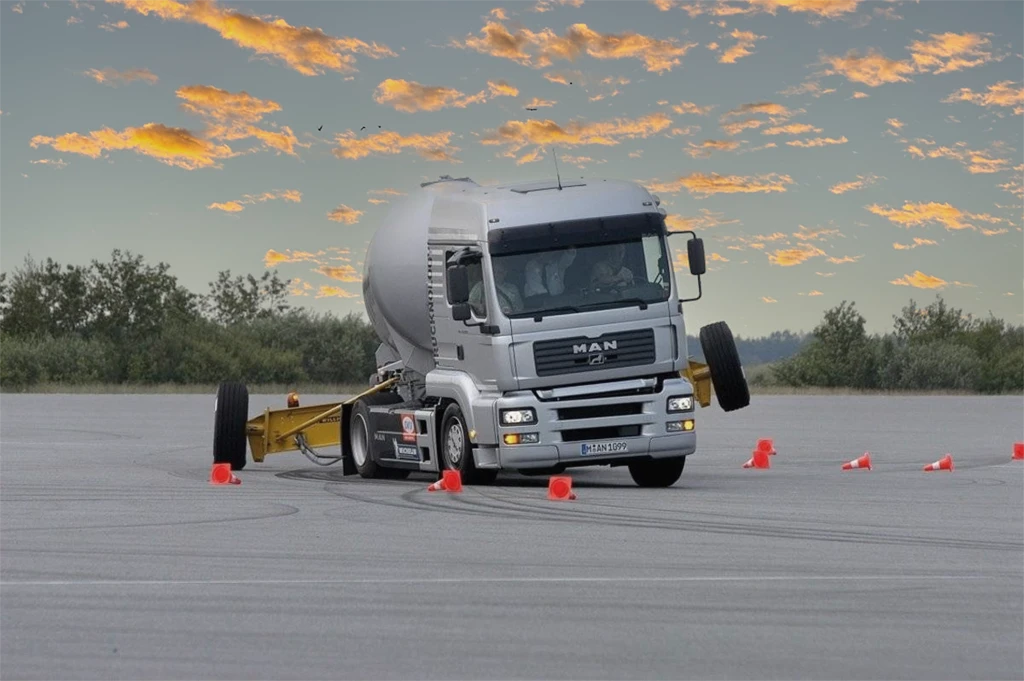
In the realm of "Intelligent Trailers," the anti-rollover system is the true game-changer. Although manufacturers use different names, the core objective is identical:
RSS (Roll Stability Support) —— ZF / WABCO
RSP (Roll Stability Program) —— Knorr-Bremse
RSC (Roll Stability Control) —— Haldex
1. Why do trailers roll over?
According to the ECE R111 standard, a rollover becomes a critical risk when lateral acceleration reaches approximately 0.4G. For trailers carrying liquids, hanging meat, or unevenly distributed loads, this threshold is even lower.
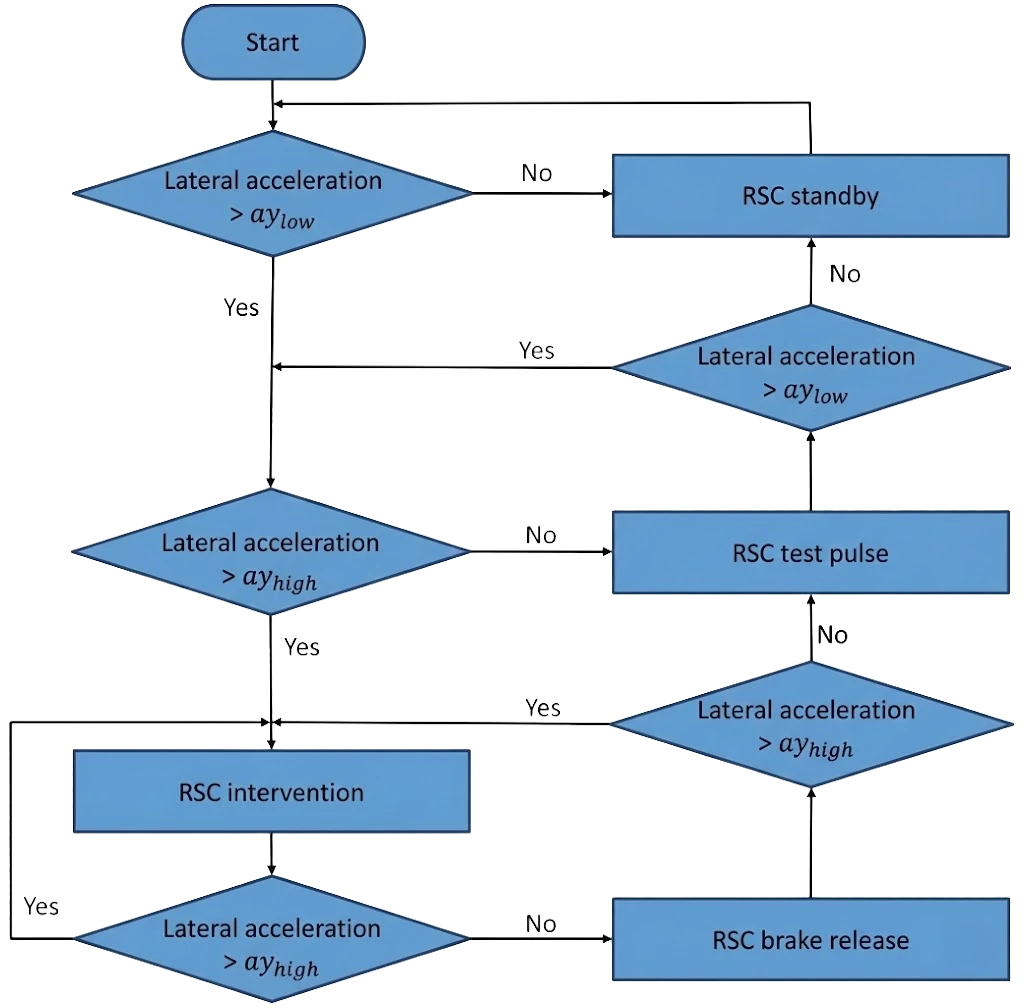
Fig 3: RSS Logic: The system actively applies brakes to specific wheels to counteract rollover forces.
2. How does it react faster than a human?
This system relies on physics and algorithms, not driver reaction time. Here are the two mainstream working logics:
🔵 WABCO RSS 3-Stage Logic
Stage 1 (Warning @ ~0.2G): Applies light braking (approx. 2 bar). Purpose: Test wheel grip and pre-charge the system, not to decelerate.
Stage 2 (Strong Intervention @ ~0.3G): If lateral force increases, the system brakes hard to forcibly reduce speed.
Stage 3 (Correction): Applies higher brake pressure to the inner wheels of the curve to prevent the trailer from straightening out abruptly, guiding it through the turn.
🟠 Knorr RSP Smart Logic
Test Pulse: When rollover risk is detected, the system sends a tiny brake signal to check if the "inner wheels" slow down.
If they slow down, they have grip. If they do NOT slow down, it means the wheels are about to lift off (slip), and the system immediately identifies high risk and applies full braking.
3. A Warning for Fleets and Drivers
🚨 System Activation = Near Miss Event
If the driver feels the trailer "tugging" back, or the telematics system reports an RSS activation, take it seriously:
Without this system, the vehicle might have already rolled over.
It is a severe warning regarding driving behavior (cornering too fast) or load distribution (CG too high).
3. EBS: Making Braking "Fast, Precise, and Stable"
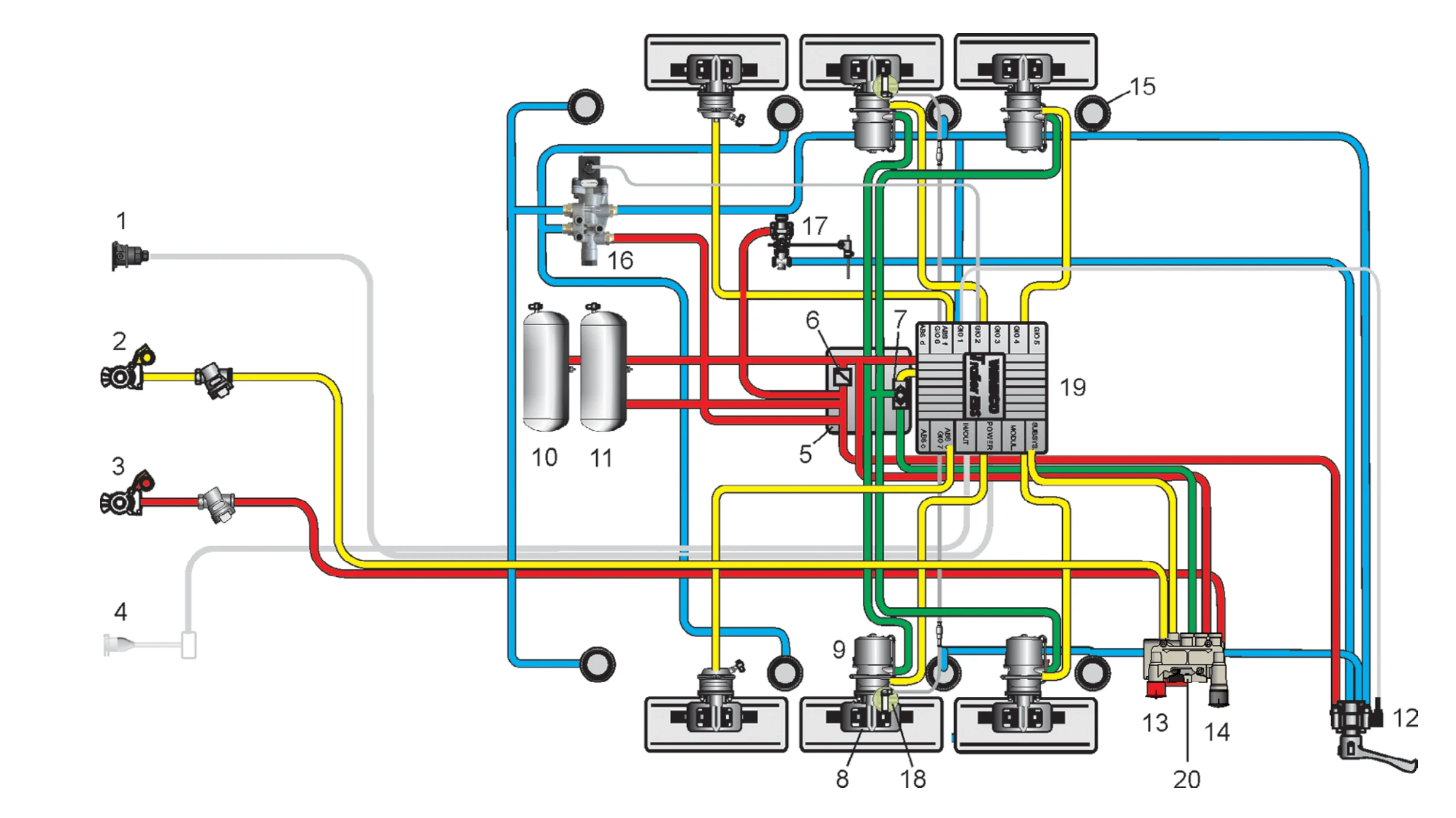
EBS (Electronic Braking System), also known as Brake-by-Wire, is not a single function but a powerful electronic control platform. It integrates sensors and actuators, often deeply linked with the air suspension.
Fig 4: EBS Braking System Schematic Integrated with Air Suspension1. ISO 7638 Power Supply 2. Service Line 3. Supply Line 4. Stop Light Power (Optional) 5. Pneumatic Extension Module (PEM) 6. Overflow Valve (Integrated) 7. Charging Valve (Integrated) 8. Service Brake Part 9. Spring Brake Chamber 10. Service Reservoir 11. Air Suspension Reservoir 12. Raise/Lower Valve 13. Red Button (Park) 14. Black Button (Release) 15. Air Bag 16. Lift Axle Valve 17. Levelling Valve 18. ABS Sensor 19. TEBS Modulator 20. PREV.
1. How it works: From "Blowing Air" to "Digital Signals"
Traditional air brakes rely on the foot pedal to control air flow physically. EBS uses a pedal position sensor to detect the driver's braking intent. The control unit calculates the required brake pressure for each axle based on speed, load, and wheel speed.
This information is transmitted via the CAN Bus to the Electro-Pneumatic Modulator (EPM), which adjusts pressure directly near the wheels. This eliminates the delay caused by long pneumatic lines.
2. Hidden Benefits of Modern EBS
Modern EBS (like systems used by Kales Vehicle) typically uses a modular design, integrating the ECU, sensors, and pneumatic control into one compact component, simplifying the trailer chassis layout.
🔍 The "Invisible Bonuses" of EBS: Not just fast, but smart
Coupling Force Control (CFC): The system optimizes the braking timing and force between the tractor and trailer, preventing "trailer push" or "tugging," making the combination drive more smoothly.
Brake Blending: Intelligently distributes deceleration intent between endurance braking (like retarders) and service braking (pads), extending brake pad life.
Lining Wear Control: Automatically adjusts braking force distribution across axles to ensure even wear on all brake pads, simplifying fleet maintenance.
Multi-Function Integration: Modern EBS modules often integrate Lift Axle Control (LAC), RSS, dynamic wheelbase control, TPMS, and overflow valves, eliminating the need for complex external plumbing.
Comparison Summary:
Feature
Traditional ABS (Pneumatic)
Smart EBS (Electronic)
Signal Transmission
Air Pipes (Slow)
CAN Bus Signal (Light Speed)
Response Delay
0.3 ~ 0.6 Seconds
Almost Zero Delay
Functionality
Anti-lock Only
Lift Axle, Wear Balance, Coupling Control
4. AEBS Synergy: The Danger of "Lag"
Although AEBS (Advanced Emergency Braking System) decisions are made by the tractor's radar and camera, the trailer's execution capability is critical.
❌ Trailer with Standard ABS only:
When the tractor triggers a violent AEBS stop, the trailer reacts with a pneumatic lag. The massive inertia of the trailer pushes the tractor forward. This extends braking distance and causes a dangerous "Pushing Effect," potentially leading to loss of control.
✅ Trailer with EBS:
As the tractor brakes, the trailer receives the signal via the ISO 11992 interface (or ISO 7638) instantly. It applies full braking force with zero delay, creating a "Stretching Effect" that keeps the entire vehicle combination straight and stable.
5. The Pyramid of Trailer Intelligent Braking
[Visual: Imagine a Pyramid Structure]
Fig 5: Hierarchy of Intelligent Safety Technology
L1 FoundationABS
Legal Baseline
L2 PlatformEBS
Electronic Brain
L3 AdvancedRSS + AEBS
Active Safety
6. Advice for Fleet Managers and Buyers
As a professional trailer manufacturer, Kales Vehicle suggests considering the following:
1. Think Long Term: Choose EBS/RSS
If you transport liquids (tank trailers), livestock, or high-value cargo, we strongly recommend EBS with RSS. While the initial cost is higher, preventing just one rollover accident covers the cost many times over.
2. Don't Ignore the "ISO 7638" Cable
A Fatal Blind Spot for Drivers! The trailer's ABS/EBS system MUST be powered and communicate via the ISO 7638 Coiled Cable (the thickest plug).
If unplugged or damaged, the most advanced EBS becomes "brain dead," reverting to an old-school air brake with NO anti-lock or anti-rollover protection. Always check before driving.
ISO 7638 Connection
3. Tractor-Trailer Compatibility
When buying, check if the spec sheet confirms "EBS Supported" and "RSS/RSP Functionality." Even if your tractor truck is state-of-the-art, an outdated trailer braking system will compromise the safety of the entire rig.
Conclusion: Safety is the Biggest ROI
In the era of intelligent transport, the trailer is no longer a silent partner. Don't just look at volume and price; ask: "Is the braking system smart enough?"
Kales Vehicle is dedicated to providing the safest, most durable semi-trailer solutions for global clients.
Keeping your Kales semi-trailer in top condition is essential for safety, compliance, and operational efficiency. Even high-quality trailers can develop issues over time due to wear, improper maintenance, or harsh operating conditions.
This comprehensive guide outlines the most common Kales semi-trailer problems, their root causes, and step-by-step solutions—organized by system for quick reference. Whether you're a fleet manager, owner-operator, or maintenance technician, this troubleshooting resource will help you minimize downtime and maximize trailer lifespan.
⚠️ Safety Warning: Always secure the trailer with wheel chocks and jack stands before performing under-chassis inspections. Ensure the air system is depressurized before disconnecting lines.
1. Brake System Failures
The brake system is critical for road safety. Ignoring early warning signs can lead to accidents or roadside violations.
1.1. Weak or Delayed Braking
Symptom
Likely Cause
Solution
Reduced braking power
Excessive clearance (drum/lining)
Adjust clearance to manufacturer specs
Worn brake linings
Replace brake shoes
Air leakage in brake circuit
Inspect lines and valves; repair leaks
Faulty emergency relay valve
Replace repair kit or valve assembly
1.2. Brakes Won’t Release (Dragging)
Symptom
Likely Cause
Solution
Brakes remain engaged
Low air pressure (<0.8 MPa)
Restore air pressure to 0.8 MPa
Broken return spring
Replace spring in brake chamber
Bent pushrod
Replace or straighten pushrod
Incorrect stroke
Re-adjust stroke length per Kales specs
1.3. ABS Warning Light On (New)
Symptom
Likely Cause
Solution
Amber ABS light stays on
Sensor gap too wide
Push ABS sensor fully against tone ring
Damaged sensor cable
Inspect wiring for cuts; replace sensor
🔧 Pro Tip: Always perform a full air system leak test during pre-trip inspections to catch issues early.
2. Suspension System Issues
Suspension problems affect ride quality, tire wear, and cargo stability.
2.1. Noises from Suspension
Symptom
Likely Cause
Solution
Clunking or rattling
Broken leaf spring
Replace spring assembly
Loose U-bolt nuts
Tighten to specified torque (refer to manual)
3. Fifth Wheel (Kingpin) Problems
3.1. Handle Won’t Lock or Feels Loose
Symptom
Likely Cause
Solution
Handle doesn’t engage fully
Improper position of locking hook
Adjust set screw on right side:
• Clockwise → reduces play (tighten)
• Counter-clockwise → eases operation (loosen)
4. Axle & Wheel Assembly Faults
4.1. Wheel Wobble or Vibration
Symptom
Likely Cause
Solution
Visible oscillation
Loose lug nuts
Retorque to manufacturer specification
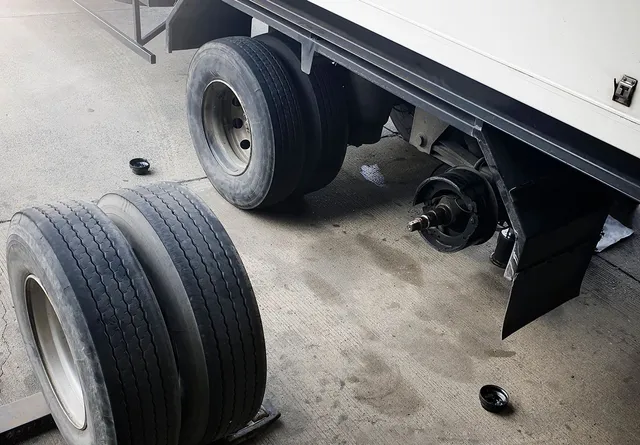
Seized axle bearing
Replace bearing immediately
Bent rim
Replace wheel assembly
4.2. Overheated Wheels (Hot Hubs)
Symptom
Likely Cause
Solution
Hot hubs after trip
Seized bearing / No grease
Replace bearing; use correct Grease (ZG-4 / Lithium)
Brake drag
Diagnose brake system (See Section 1)
Over-tightened axle nut
Loosen and re-torque to spec
4.3. Uneven Tire Wear
Symptom
Likely Cause
Solution
Shoulder wear / Feathering
Axle misalignment
Adjust tie rods; check alignment
Center wear
Over-inflation
Inflate to Kales-recommended PSI
Cupping
Worn suspension parts
Replace bushings or shocks
5. Landing Gear Malfunctions
5.1. Hard to Crank or Stuck
Symptom
Likely Cause
Solution
Excessive resistance
Poor lubrication
Apply grease to gears and screw
Bent leg tubes
Replace damaged leg section
Grinding noise
Worn gears
Disassemble and replace gear set
6. Electrical System Failures
Electrical faults compromise visibility. Most issues are caused by poor grounds or corrosion.
6.1. Lights Not Working
Symptom
Likely Cause
Solution
Lights flickering / Dim
Bad Ground Connection
Clean chassis ground point; check for rust
One light out
Burned-out bulb
Replace bulb; check socket corrosion
No lights working
Loose 7-way plug
Clean contacts; spread pins for better fit
Final Thoughts: Prevention Is Better Than Repair
Most Kales semi-trailer failures stem from neglected maintenance or incorrect servicing. By following a structured inspection schedule—and addressing minor issues early—you can avoid costly repairs, roadside breakdowns, and safety incidents.
Need Replacement Parts?
Don't let a breakdown keep you off the road. We stock genuine Kales components.
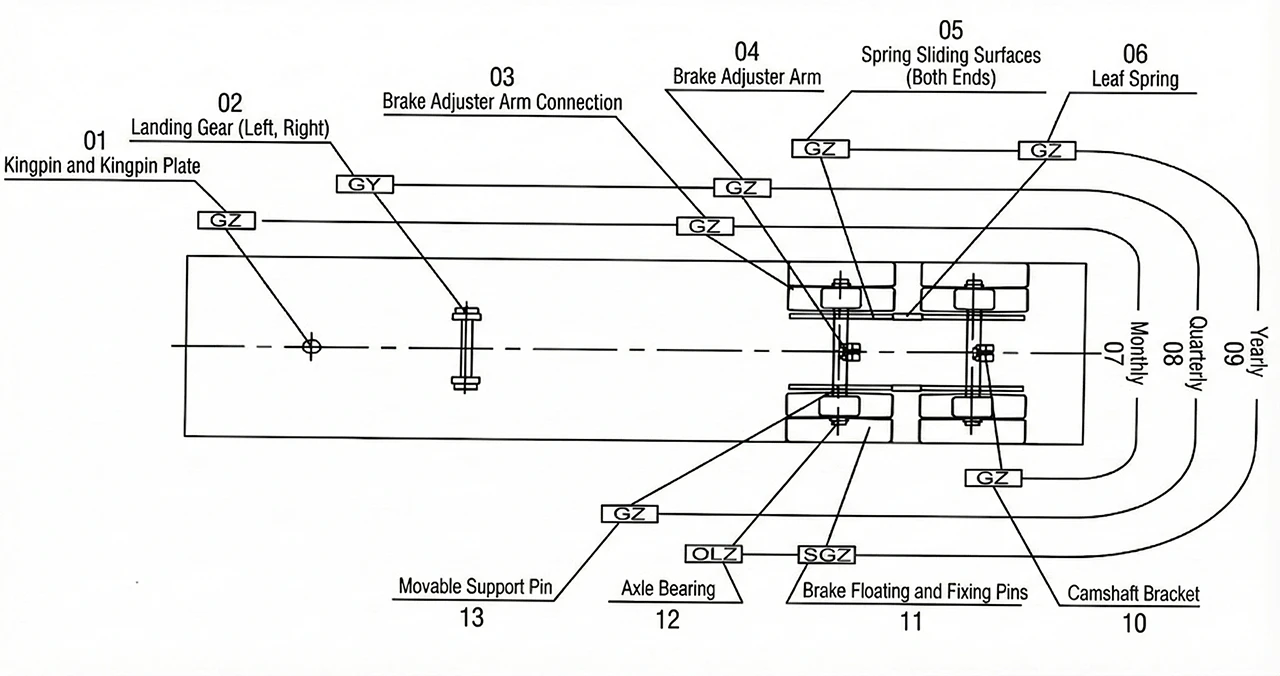
Proper lubrication is one of the most critical yet often overlooked aspects of Kales semi-trailer maintenance. Regularly greasing the right components with the correct lubricants not only ensures smooth operation but also prevents premature wear, enhances road safety, and significantly extends your trailer’s service life.
In this guide, we’ll walk you through everything you need to know about lubricating your Kales semi-trailer—from recommended grease types and lubrication intervals to best practices that keep your fleet running efficiently.
Why Lubrication Matters for Your Kales Semi-Trailer
Friction is the silent enemy of heavy-duty trailers. Without adequate lubrication, you risk:
Accelerated wear on moving parts
Heat buildup in axle bearings and joints
Component seizure or unexpected failure
Reduced fuel efficiency due to increased rolling resistance
Increased Safety Risks: Especially in critical systems like brakes and suspension.
By following a structured Kales semi-trailer lubrication schedule, you protect your investment, reduce repair costs, and avoid costly roadside breakdowns.
Recommended Lubricants for Kales Semi-Trailers
Kales specifies three primary grease types. Using the correct lubricant is essential. Below is a comparison of the Chinese Standards (found in your manual) and their International Equivalents for global maintenance teams.
Code
Lubricant Name
Standard (China)
International Equivalent (Ref.)
Recommended Use Case
GZ
Calcium-Based Grease
ZG-4
NLGI #2 (Calcium)
General-purpose, moderate temps, chassis points
QLZ
Automotive Universal Lithium Grease
GB5671-85
NLGI #2 (Lithium EP)
High-load, multi-point applications (Axles)
SGZ
High-Temperature Grease No. 4
ZN6-4
NLGI #3 (High Temp)
High-heat zones (e.g., brake pins)
⚠️ Critical Warning: Never mix different grease types (e.g., Calcium vs. Lithium). This can cause chemical incompatibility, leading to grease separation and bearing failure.
Below is the official maintenance chart detailing daily, monthly, and annual greasing points.
Lubrication Frequency Chart
Lubrication Point
Daily
Monthly
Annually
Recommended Lubricant
Kingpin & Fifth Wheel Plate
✓
Calcium-Based (ZG-4 / NLGI #2)
Landing Gear (Support Device)
✓
Calcium-Based (ZG-4 / NLGI #2)
Brake Slack Adjuster
✓
Lithium Grease (GB5671 / NLGI #2 EP)
Slack Adjuster Linkage
✓
Calcium-Based (ZG-4 / NLGI #2)
Leaf Spring Pins & Slides
✓
✓ (Ends)
Calcium-Based (ZG-4 / NLGI #2)
Brake Camshaft Bracket
✓
Calcium-Based (ZG-4 / NLGI #2)
Axle Wheel Bearings
✓
Lithium Grease (GB5671 / NLGI #2 EP)
Container Twist Lock Pins
✓
Calcium-Based (ZG-4 / NLGI #2)
🔧 Pro Tip: Daily greasing points are typically high-wear components exposed to road debris. Treat these as part of your standard pre-trip inspection.
Lubrication Best Practices
✅ DO:
Use clean equipment: Wipe grease fittings (zerks) before attaching the gun to prevent forcing dirt inside.
Purge old grease: Apply new grease until you see fresh grease purging from the joint to remove contaminants.
Log it: Record all maintenance in your fleet log for compliance and warranty purposes.
❌ DON’T:
Don't mix grease bases: Stick to one type or thoroughly clean the component before switching.
Don't over-pressurize sealed bearings: This can blow out the seals and invite contamination.
Don't ignore winter needs: Cold temperatures thicken grease. Ensure your lubricant is rated for your operating temperature.
Frequently Asked Questions (FAQ)
How often should I grease the Kingpin on a Kales Trailer?
The Kingpin and Kingpin Plate are high-friction areas that carry the trailer's weight. Kales recommends greasing these daily or prior to every new coupling to prevent grinding and uneven wear.
What is the best grease for trailer axle bearings?
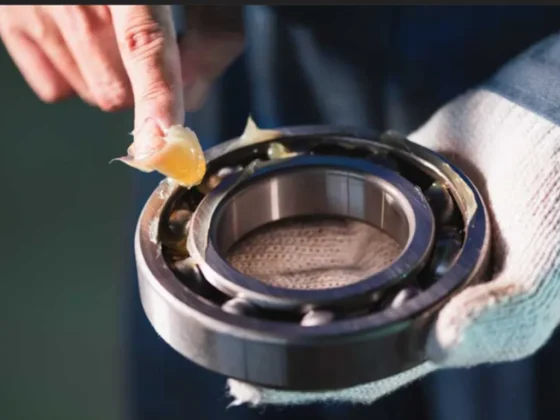
For axle bearings (Point 12), use a high-quality Automotive Universal Lithium Grease (NLGI #2 EP). This resists high temperatures and heavy loads better than standard chassis grease.
Why do my trailer brakes squeak even after greasing?
Squeaking can occur if the Camshaft Bracket or Brake Pins are dry. Ensure you verify points 10 and 11 on the diagram. If greased and still noisy, check for worn linings or glazed drums.
Final Thoughts: Lubrication = Reliability
For fleet managers and owner-operators, consistent lubrication is non-negotiable. By adhering to Kales’ recommended grease types and maintenance intervals, you ensure driver safety, regulatory compliance, and maximum ROI.