Container & Bulk Transport Product Guide · Published: October 23, 2024 · Updated: June 3, 2026 · By Kales Vehicle Engineering Team · Reviewed by Kales Export Sales Engineering · Market focus: port logistics, inland container haulage, depot shuttle, and regional export routes
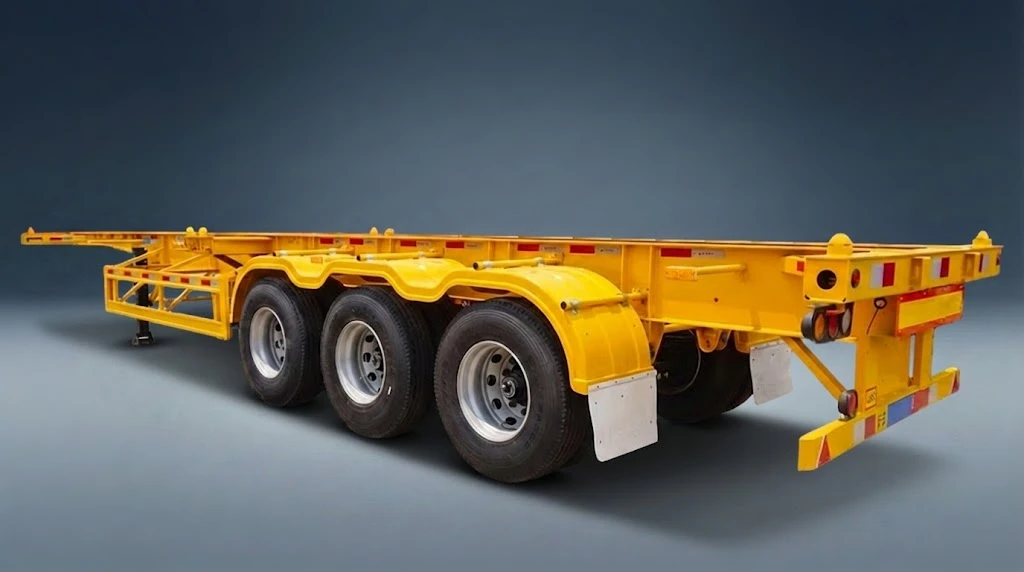
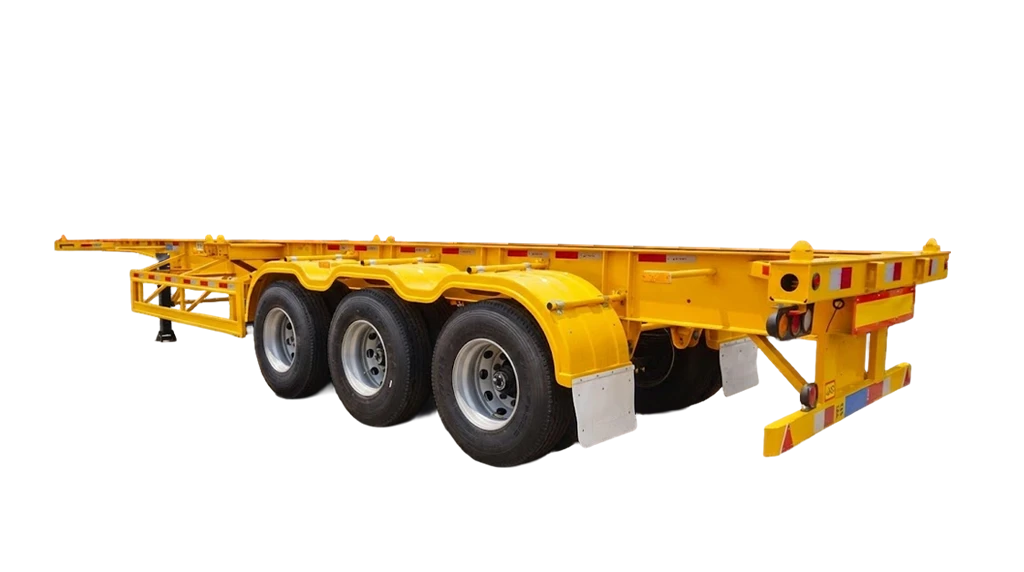
40ft container chassis semi trailer: this Kales 3 axle skeletal trailer is built for fleets that need one standard chassis for 20ft and 40ft ISO container work without paying for a heavier multi-axle specification they do not actually need. It fits port shuttle operations, inland container corridors, and regional yard-to-warehouse transport where durability, lock security, and serviceable hardware matter more than decorative features.
Engineering guidance from the Kales Vehicle product team for buyers comparing a standard 3 axle 40ft container chassis with heavier 4 axle skeleton trailer programs.
Quick answer: Choose this 40ft container chassis semi trailer when your work is standard ISO 20ft and 40ft container transport and you want the mainstream 3 axle layout for port operations, depot dispatch, and inland haulage. It is the right fit for buyers who need a dependable skeletal trailer with 12 twist locks, a reinforced gooseneck, and a practical 40T to 60T configuration. Move to a 4 axle skeleton only when axle load distribution, route regulation, or heavier container duty already requires that step.
Why Buyers Choose This 40ft Container Chassis
- Mainstream 3 axle layout: better matched to standard container haulage than a heavier 4 axle program when the route does not require extra axle count.
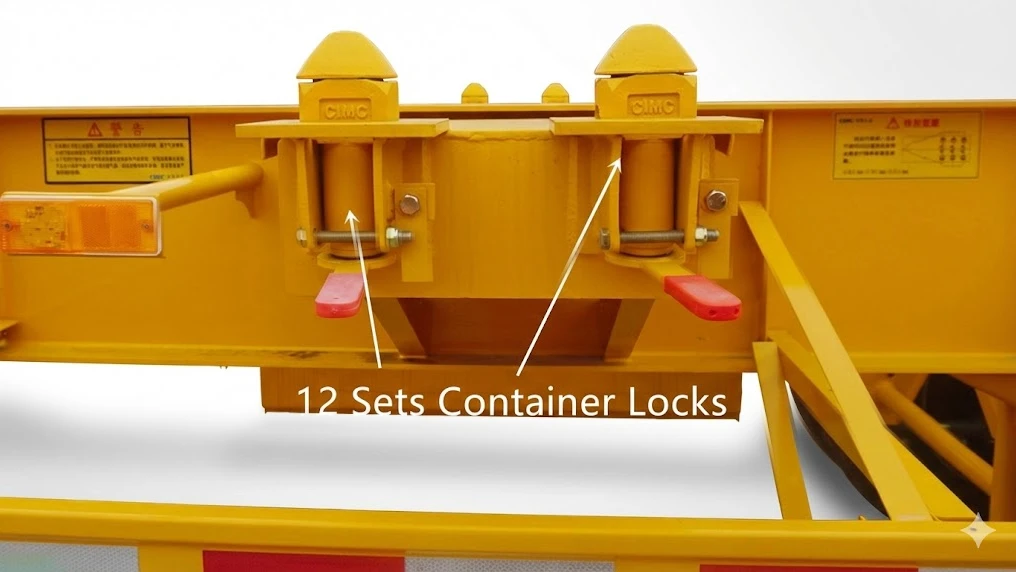
- 12-lock flexibility: carries one 40ft container, two 20ft containers, or one centered heavy 20ft load depending on dispatch pattern and legal requirement.
- T700 main beam: stronger anti-sag performance than ordinary carbon-steel chassis while helping control tare weight.
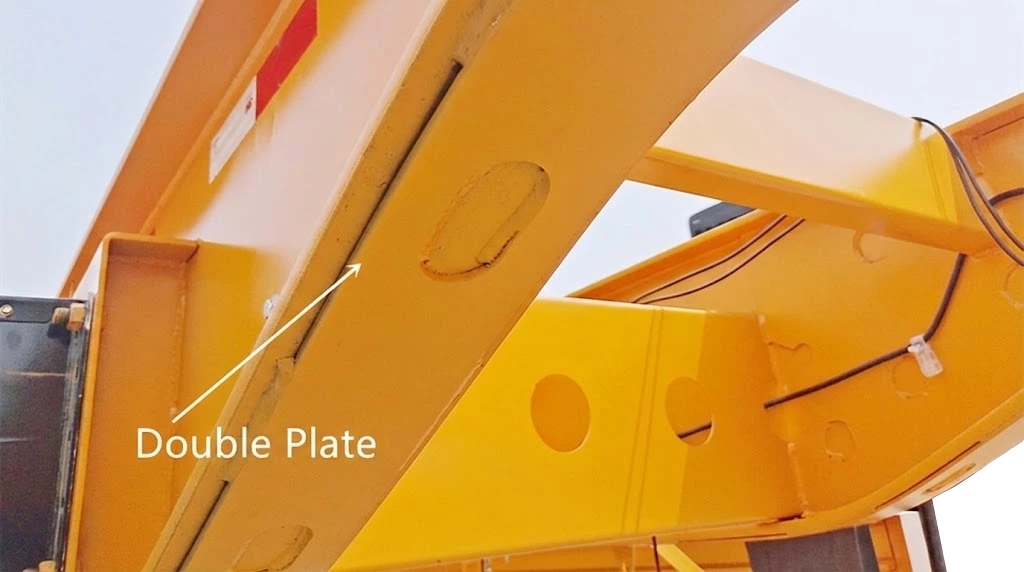
- Reinforced gooseneck: double-layer reinforcement at the high-stress braking zone reduces the sag and crack risk common on cheaper skeleton trailers.
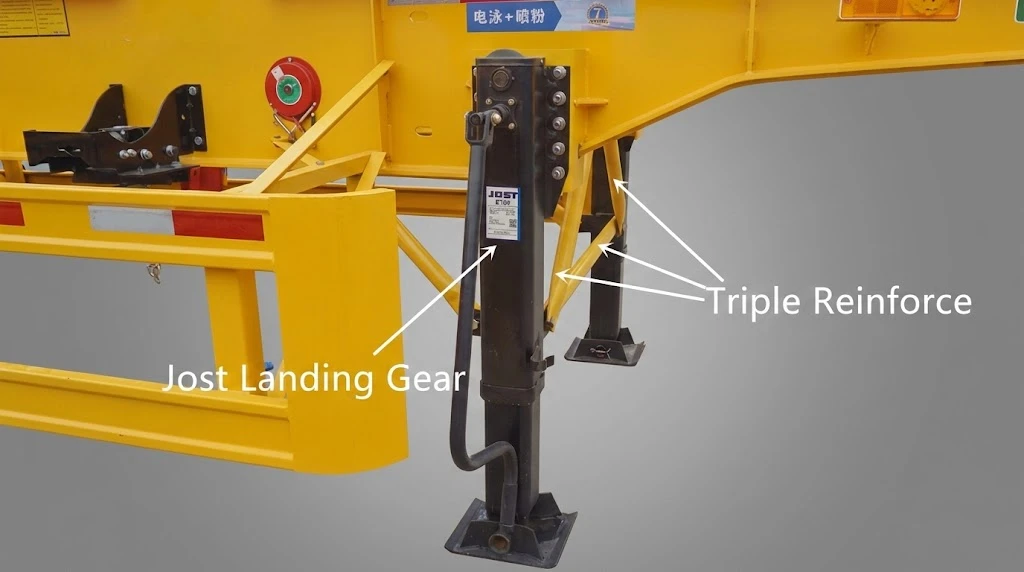
- Serviceable global hardware: JOST landing gear, WABCO brake components, and mainstream axle options simplify maintenance after import.
- Shipping efficiency: stackable chassis logic helps reduce ocean freight cost per unit on export orders.
Specification-backed advantages
- Overall dimensions: 12,360 mm x 2,500 mm x 1,520 mm, standard ISO chassis envelope. This provides a concrete durability and load-control basis for the stated duty cycle.
- Payload class: 40T standard configuration, up to 60T in heavier-duty matching. This defines the working band to validate against the cargo, route, and local legal limits.
- Twist locks: 12 ISO twist locks, screw type or lifting type depending on program. This directly supports the loading, unloading, or handling workflow described for this product.
Technical Snapshot
| Product type | 3 axle 40ft skeletal trailer / container chassis semi trailer |
|---|---|
| Container fit | One 40ft container, two 20ft containers, or one centered heavy 20ft container |
| Overall dimensions | 12,360 mm x 2,500 mm x 1,520 mm, standard ISO chassis envelope |
| Payload class | 40T standard configuration, up to 60T in heavier-duty matching |
| Main beam | T700 high-strength steel main beam, 450 mm to 500 mm beam depth |
| Twist locks | 12 ISO twist locks, screw type or lifting type depending on program |
| Axles | 3 axles, 13T or 16T; FUWA, KALES, BPW, or SAF matching |
| Suspension | Reinforced mechanical leaf spring suspension standard, air suspension optional on selected logistics routes |
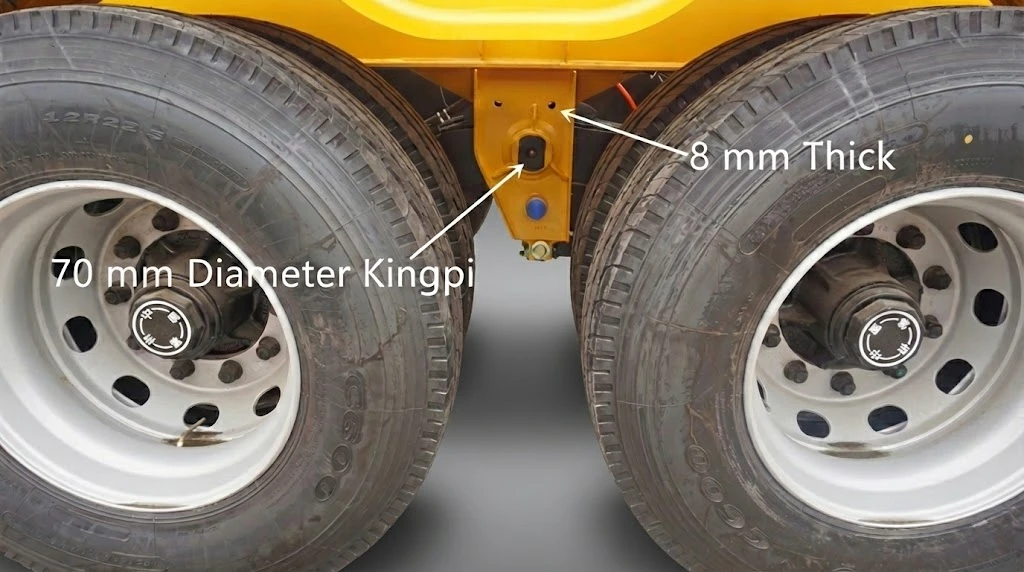
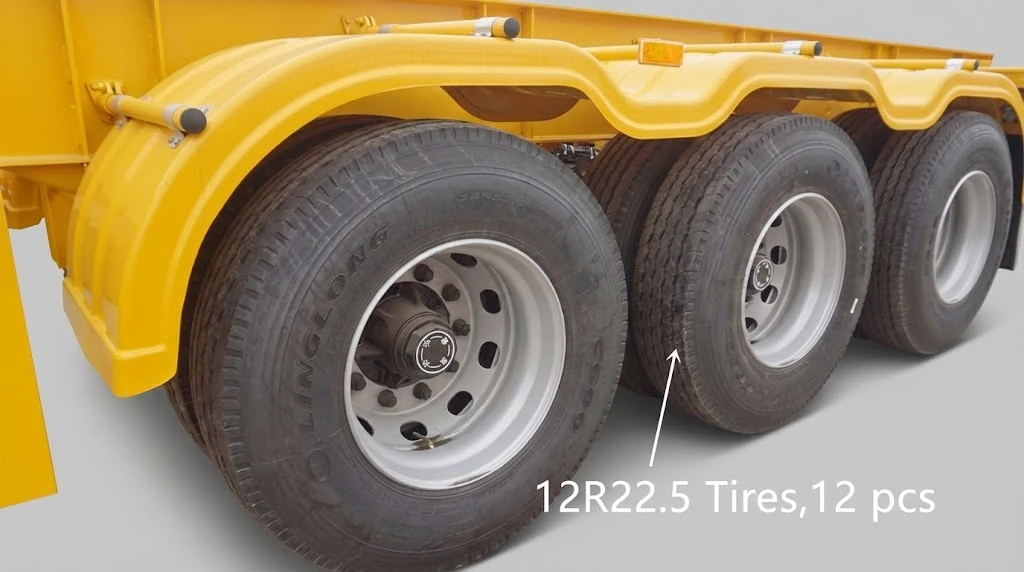
| Tires | 12 units, 12.00R22.5 radial or 315/80R22.5 tubeless depending on final setup |
| Kingpin | JOST 2 inch or 3.5 inch, bolted or welded program |
| Landing gear | JOST D200T, 28T lifting capacity |
| Brake system | WABCO emergency valve and 6 double air chambers |
Best Fit Operating Profile
This trailer fits container fleets that need a durable but still mainstream 40ft chassis for port pickup, inland dispatch, container depot transfer, and regional freight. It is especially useful when the route is centered on ISO box handling and the business does not need the cost and axle complexity of a heavier 4 axle chassis from day one.
Best for
- Port-to-yard and yard-to-warehouse shuttle operations
- Standard ISO 20ft and 40ft container work on regional and cross-border routes
- Buyers who want the mainstream 3 axle chassis before moving into heavier 4 axle container duty
- Operators who need secure twist-lock engagement, reinforced structure, and easy spare parts sourcing
Not ideal for
- Routes that already require a 4 axle chassis for legal load distribution or heavier container concentration
- General freight that should be loaded on flatbed, dropside, or curtainsider trailers instead of a skeletal frame
- Projects where the container is not the cargo unit and a different trailer body is required
Why a 3 Axle 40ft Chassis Is Still the Core Port Logistics Spec
Many buyers searching for a 40ft container chassis semi trailer do not need the heaviest solution in the catalog. They need the standard answer that works every day. The 3 axle format remains the core port-logistics spec because it balances payload, structure, maneuverability, and acquisition cost across mainstream container operations.
| Buyer situation | Best-fit Kales option | Why |
|---|---|---|
| Standard 20ft and 40ft ISO container haulage on mainstream routes | This 3 axle 40ft container chassis | Best balance of standard axle count, structural strength, and cost |
| Heavier container duty or route rules demanding more axle distribution | 4 axle 12m skeleton trailer | Extra axle support for higher regulatory or payload pressure |
| Non-container freight on an open deck | 40ft flatbed semi trailer | More suitable when the cargo is not an ISO container |
| Palletized protected freight with side loading needs | 13m curtainsider semi trailer | Curtain-side structure suits pallet cargo better than a bare chassis frame |
Engineering and Serviceability Details
T700 beam and reinforced suspension hanger logic
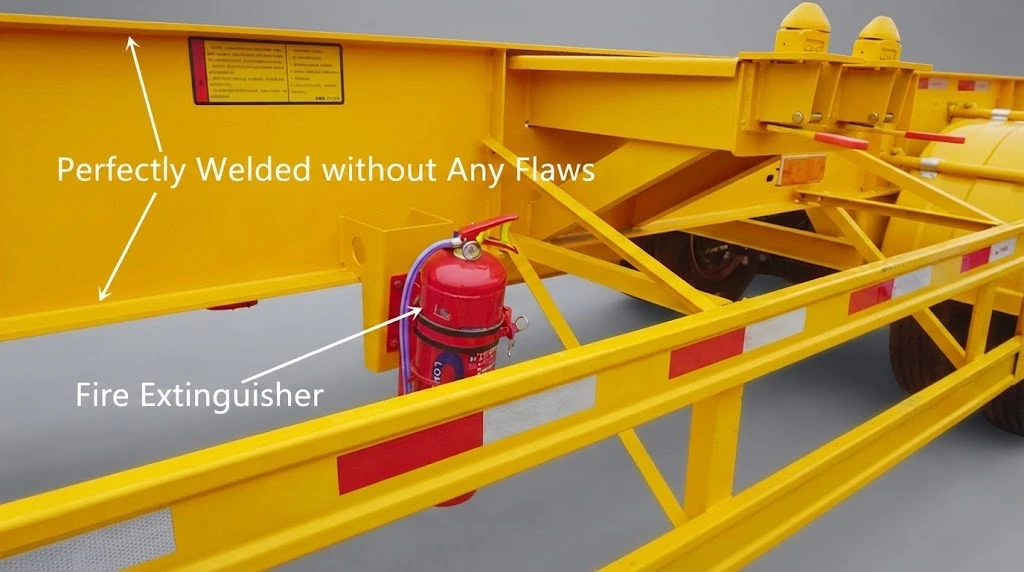
A low-cost container chassis often fails at predictable points: the main beam, the gooseneck transition, and the suspension hanger area. That is why this product uses a T700 beam and reinforced hanger structure rather than relying on generic carbon-steel sections. The aim is to control fatigue and prevent early cracking in daily port cycles.
12 twist locks and dispatch flexibility
The value of a chassis is not only that it can carry a 40ft box. It is that it can do different ISO jobs safely. The 12-lock layout gives operators more dispatch flexibility across one 40ft, two 20ft, or one centered heavy 20ft container depending on route and legal pattern.
Reinforced gooseneck and braking load concentration
The gooseneck area takes repeated stress during emergency braking and uneven road impact. On cheaper chassis this is where sagging starts. The double-layer reinforcement at the gooseneck is there to handle that concentration zone more intelligently and extend structural life.
Mechanical versus air suspension
Mechanical suspension remains the default because container chassis often run in harsher port and yard environments where repair simplicity matters. Air suspension is possible, but it only becomes the better answer when the route profile, maintenance network, and ride requirement justify it.
Quotation and Procurement Guidance
Buyers often compare a 40ft skeletal trailer only by axle brand and base price. That misses the real procurement question: how well the chassis handles concentrated container loads, poor port surfaces, and inland transport abuse over time. A weak chassis that looks cheap on day one becomes expensive once the beam, hanger, or gooseneck starts to move.
Kales can customize axle brand, twist-lock format, suspension, kingpin, landing gear, and reinforcement level before production. The right build depends on whether your work is port shuttle, inland container freight, bonded cargo transfer, or heavier concentrated 20ft box movement.
Factory Images and Inspection Views
Frequently Asked Questions
Can this chassis carry two 20ft containers safely?
Yes. The 12-lock layout is designed for that dispatch pattern, provided the final payload and route remain within the correct legal and engineering configuration for the market.
When should I move from 3 axles to 4 axles?
Move to 4 axles when local regulation, heavier concentrated container loads, or route conditions already require broader axle-load distribution. If your operation is mainstream port and inland container work, the 3 axle chassis is usually the more rational answer.
Why does the gooseneck reinforcement matter so much?
Because the gooseneck sees repeated stress during braking and poor-road impact. Reinforcing that area helps prevent sagging and structural cracking over time.
Can this trailer be shipped in stacked form?
Yes. Kales can prepare stackable shipping for bulk or Ro-Ro export programs to reduce ocean freight cost per chassis.
Should I choose mechanical or air suspension?
Mechanical suspension remains the default for most container chassis because it is simpler and tougher in port and yard use. Air suspension is an option when the route is smoother and the operating profile justifies the extra system complexity.
Request Drawing and Quote
If you are comparing a 40ft container chassis semi trailer for port logistics, inland container haulage, or depot transfer, send your container mix, route country, target payload, and whether you need standard or heavier-duty reinforcement. Kales can then match the axle package, twist-lock layout, suspension, and beam program to the real work.
- Email: jennylee@kalestruck.com
- WhatsApp: +86 131 5638 8843
Related Kales Container and Logistics Options
- 4 Axle 12m Skeleton Trailer for buyers who already need a heavier axle-distribution container chassis.
- 40ft Flatbed Semi Trailer for open-deck freight that is not moving in ISO containers.
- 13M Curtainsider Semi Trailer for palletized cargo that needs weather protection and side loading.